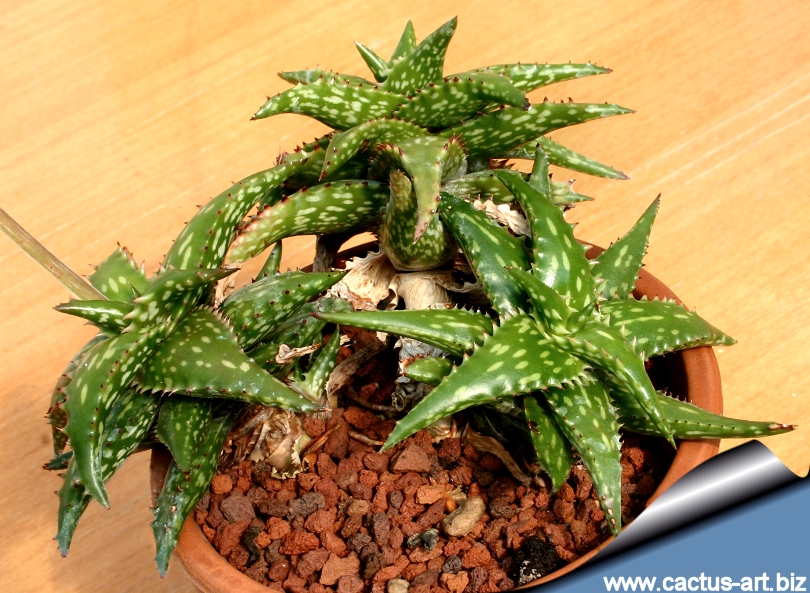
Description: It is a miniature aloe with
rosettes. Suckering to form dense groups up to 35 cm tall and 0,6-1 m in
diameter.
Stem: Acaulescent to short branching.
Rosettes: Small up to 5-8 cm in diameter with up to 12 leaves.
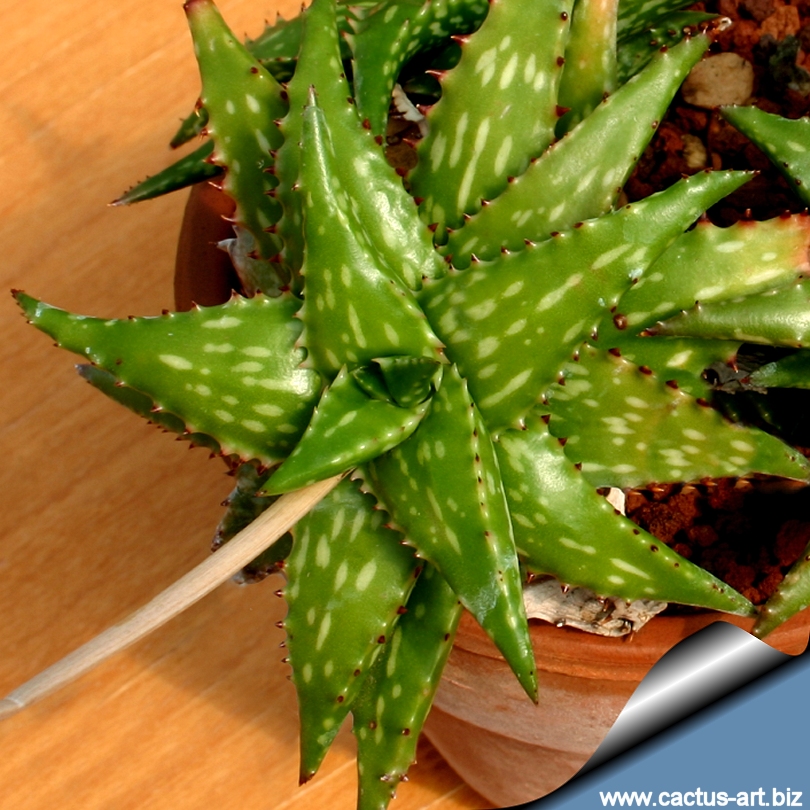
Leaves: Densely rosulate, ovate accuminate, 4 cm long and 2-5 cm
wide, glossy shiny dark green, and almost 'plastic-like' in
consistency, flecked with transparent cream spots,
surface smooth. The leaf margins are red-brown with a few
pungent teeth up to 2 mm long and 3-4 mm apart. These turgid leaves recurve and look very nice.
Exudate yellow.
Flower: The flowers are pale pink to coral pink 20-30 mm long and 5 mm across,
on a 30cm tall simple stalks, the raceme is cylidindrical with about 20
flowers .
Blooming season: The flowers are produced all year round
whenever the growing condition are adequate.
Cultivation: Very easy species, and easy to find, too
(commonly sold at outlet garden centres). It
slowly clumps to fill out small pans to form very attractive small
domes. To reach this state, however it requires patience and a careful
hand with watering. Water regularly in spring and summer, keep drier in
winter.
Prefer half shade (kept away from direct sun in summer) but it will get
nicely redder colour with brighter light (not direct sun). Given the
right conditions they can be grown as a houseplant.
Reproduction: Usually by Offsets or (rarely)
by seeds, it has to be restarted periodically as the lower leaves shed
and it looks bare.


 Cultivation and
Mail Sale
Cultivation and
Mail Sale