|
|
|
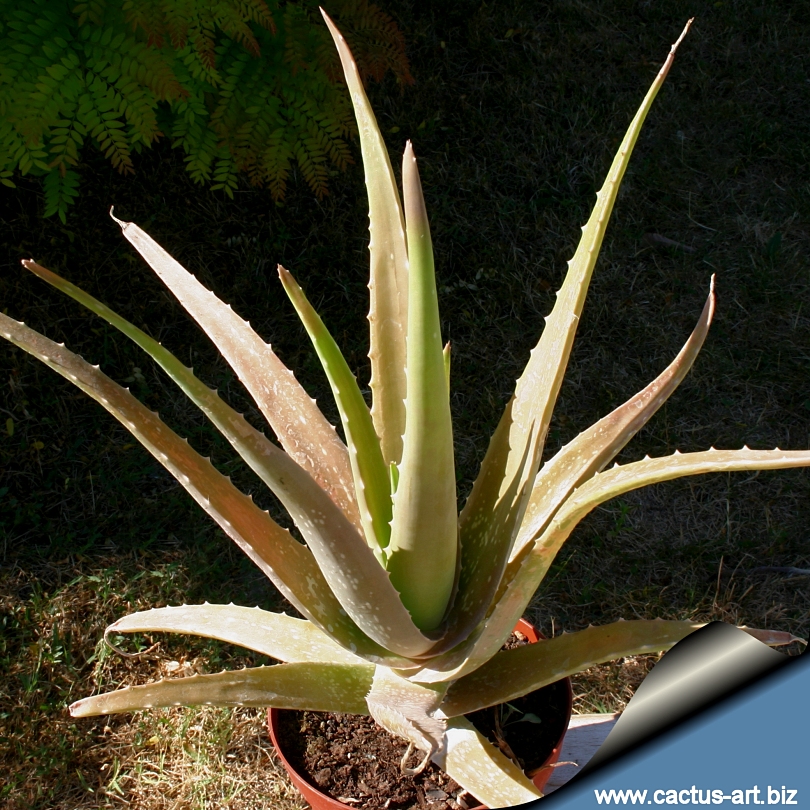
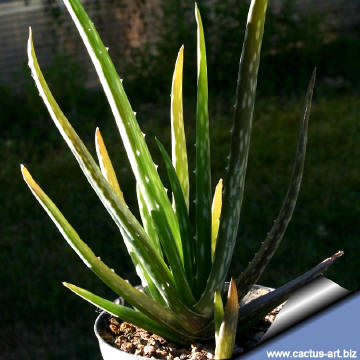
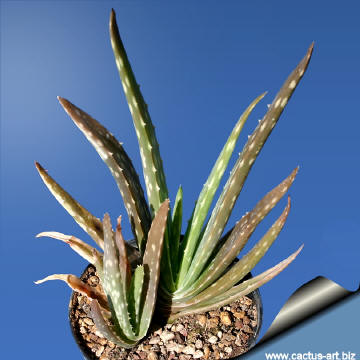
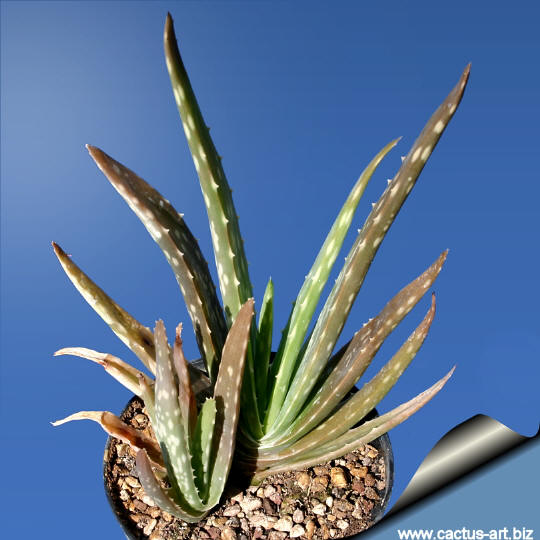
Some authors identifies the white spotted form of A.
vera as A. vera var. chinensis, however, the species varies widely with
regard to leaf spots and the spots usually present on young plants
tends to fade with age.
|
|
Description: Clumping suckering succulent with
short stems leading to compact stiff rosettes growing to 60–100 cm tall,
composed of leaves which are usually, each about 20 cm long. Aloe vera
is widely cultivated and plus than 150 different clones and variety are
available. Nomenclature is controversial too; The species does not have
any naturally occurring populations though closely related Aloes occur
in northern Africa, but it is mentioned even in very ancient Chinese
texts on medicine. As this spotted plant is not the grey surfaced form
found in the Canaries, this is considered to have undergone many re-selections
over the centuries and is occasionally designated as the form 'Chinensis.'
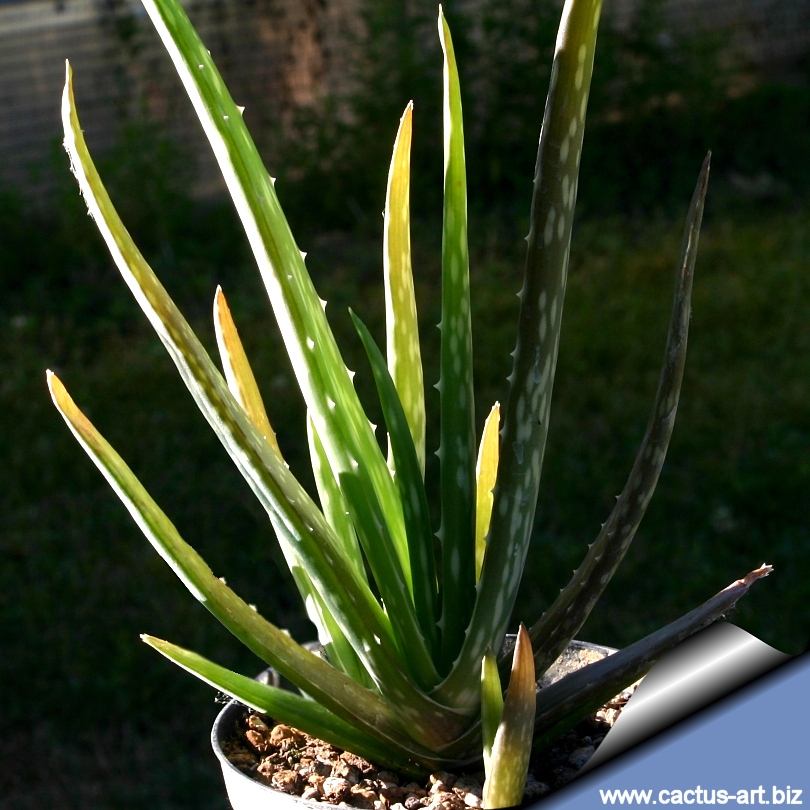
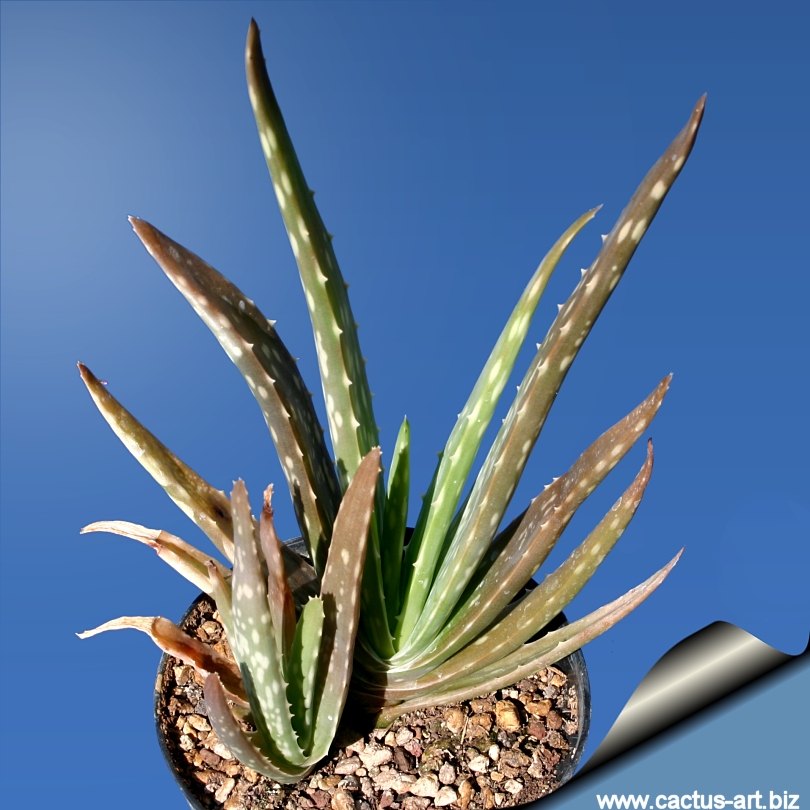
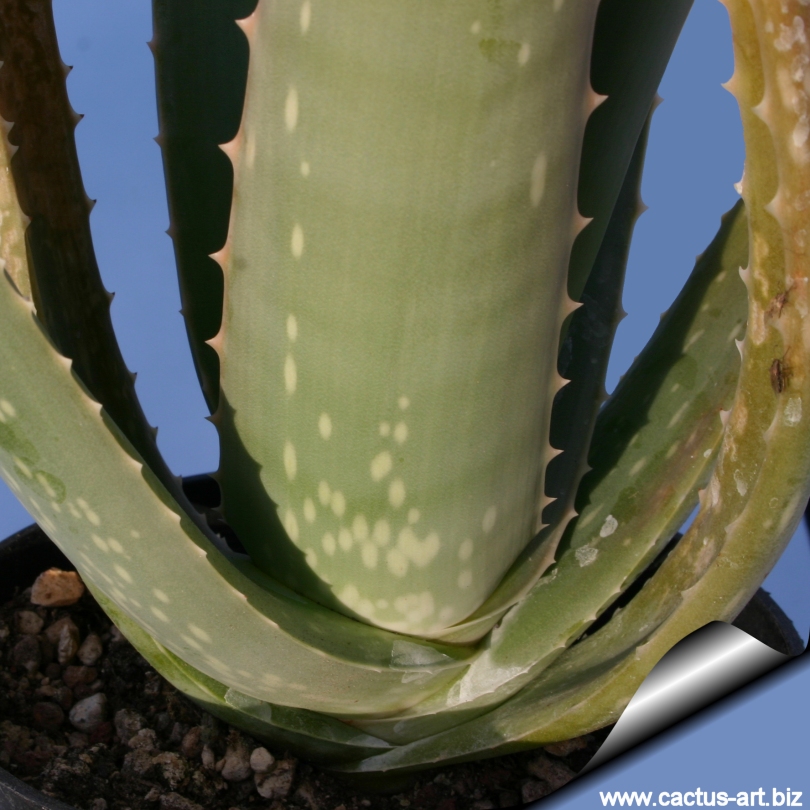
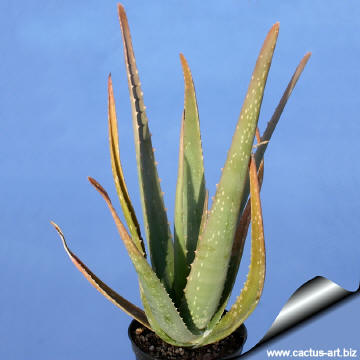
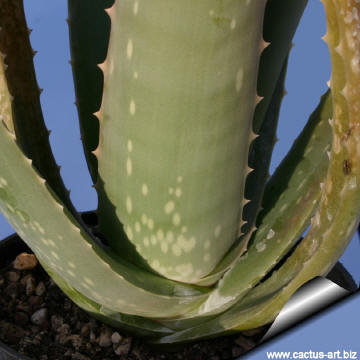
Leaves: Large fleshy, dagger-shaped, channelled bluish or grey-green,
with some varieties mottled with purple or white spots on the upper and
lower leaf surfaces, however the spots tends to fade with age. The
juvenile specimens have narrower leaves with lighter spots, while mature
specimens have wider solid green leaves. Some of the Aloe vera sold
retain the juvenile characteristics. They have spiked edges (serrated)
with small white teeth or may be smooth.
Flower: Showy, tubular 2–3 cm long, borne on ann up to 90 cm tall
spike, each flower pendulous in tones of yellow, but many of the clones
available have orange flowers.
Blooming season: Summer.
|
|
 |
 |
|
 |
 |
|


Advertising
|
|
|
|
|
Family: Asphodelaceae
Scientific name: Aloe Vera
(L.) Nicolaas
Laurens Burman
in: Flora Indica 6th of
April, 1768
Origin: Probably originated in northern Africa
(Algeria, Morocco, and Tunisia, along with the Cape Verde Islands,
Canary Islands, Maderia) but diffused and cultivated throughout the
world.
The species is widely naturalised elsewhere, occurring in temperate and
tropical regions of Australia, India, Vietnam, Taiwan, Barbados, Belize,
Nigeria, Paraguay and the USA. It has been suggested that, like many
Aloes, the species is originally from Southern Africa and that
populations that occur elsewhere are the result of human cultivation.
Common English Names include:
Medicinal Aloe, Chinese Aloe, Indian
Aloe, Medicine plant, True Aloe, Barbados Aloe, Burn Aloe, First Aid
Plant, Bitter Aloe, Wand of Heaven and Miracle Plant.
Etymology: The genus name "Aloe" is derived from the Arabic,
"alloch" and translated as "alla" in Greek and Hebrew, literally meaning
bitter or bitter sap which is descriptive of Aloe sap. The species name
"vera" means true or genuine.
Synonyms:
- Aloe perfoliata var. vera
Carl Linnaeus 1753 (basionym)
- Aloe barbadensis Philip
Miller 1768
- Aloe indica Royle
- Aloe vulgaris Lam.
- Aloe chinensis
- Aloe elongata
- Aloe flava
- Aloe lanzae
- Aloe perfoliata var. barbadensis
- Aloe vera var. chinensis
- Aloe vera var. littoralis
- Aloe vera var. wratislaviensis
- Aloe barbadensis var. chinensis
- Aloe vera var. lanzae
|
|
|
|
It is a popular houseplant with a long history as a multipurpose
folk remedy.
|
|
Cultivation: Very commonly encountered, it is a resistant
plant that tolerates poor soil and drought, but requires excellent
drainage and usually does not give many problems in cultivation.
It is a particularly fast-growing, tough and
adaptable species. Needs bright sunny conditions but enjoy some shade in
summer. Abundant irrigation at time of growth. The plants favour
mild to hot summers. They can resist some cold and occasional snow in
the rainy season although the frosts produce wounds
and burns that disfigure their aspect. Needs protection only against
severe frost. (The leaf tips get damaged below -3°C).
Grow it in light, fertile, well-drained, moderate soils, with a slightly
acidic pH (5-6). .
Plant in rock gardens and flower pots. Also suitable for coastal
planting.
It is a profusely suckering species, and one plant can eventually cover
a large area. The plant in itself is very tough and can survive often
for several seasons without water, at which point the leaves turn a
reddish colour, a sign generally associated with stress.
Maintenance: Removal of old flower
stalks; Divide the crowded
clumps periodically. During the
winter months A. vera may become dormant, during which little
moisture is required, and the plants should be
grown cool to initiate flower
development (about 5-10°C ) In areas that receive frost or
snow the species is best kept indoors or in heated glasshouses.
Reproduction: By
division
of
offshoots
that develop around the outside of the main rosette in
spring.
The best results are achieved by simply making stem cuttings. Allow
cuttings to dry for a few days and insert into river sand and keep
moist. The roots appear after about two weeks.
|
|
USE: Aloe vera is renowned for its medicinal and cosmetic
uses, however scientific evidence for the the effectiveness of Aloe
vera is limited and contradictory. Its leaf containing 12 vitamins
and several other active ingredients. It is widely used in alternative
medicine. The moist gel inside the Medicinal Aloe leaves is used for the
treatment of burns, cuts, sunburn, eczema and other skin complaints. It
is also widely used in cosmetics. As a food, A. vera is very
bitter and unpalatable and mildly toxic if ingested.
|
|