|
|
|
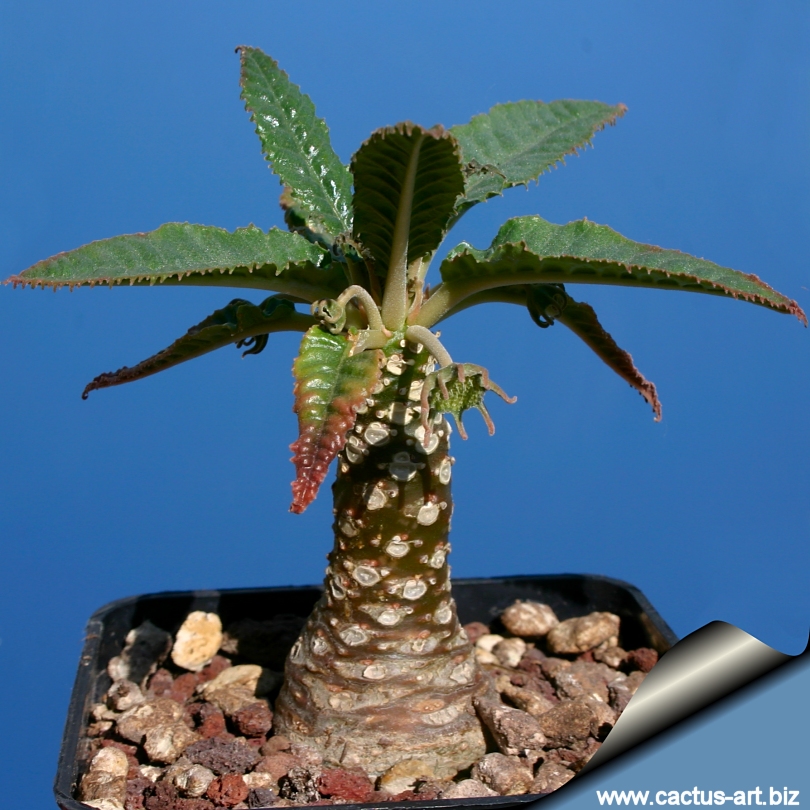
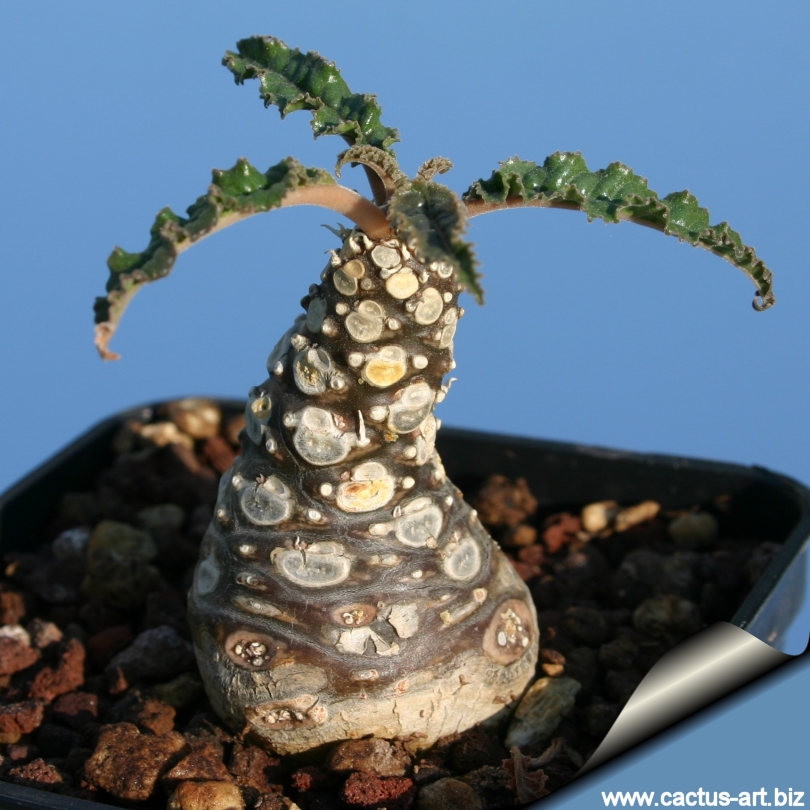
Dorsteinis sp. ( foetida form) is a strange, odd-looking
relative of the fig.
A single-stemmed plant, fully leafed out, looks like a miniature Palm
Tree.
The
stem bears conspicuous and prominent round scars of petioles,
inflorescences and stipules in a spiral pattern.
|
|
Description
(Dorstenia foetida):
It is a perennial sub-shrub, stem succulent which may be branched or
not. This is a very variable species especially in shape and size of
leaves, and length of petioles and
stipules.
Since the various forms
are connected by intermediates it is impossible to recognize
infraspecific taxa.
Stems: It has a thick, dark green- to mahogany-colored conical
trunk, that will grow to 15 centimeters in diameter and 30-40 centimeters
in height, older parts often with peeling bark. The stem bears conspicuous
and prominent round scars of
petioles, inflorescences and stipules in a
spiral pattern,
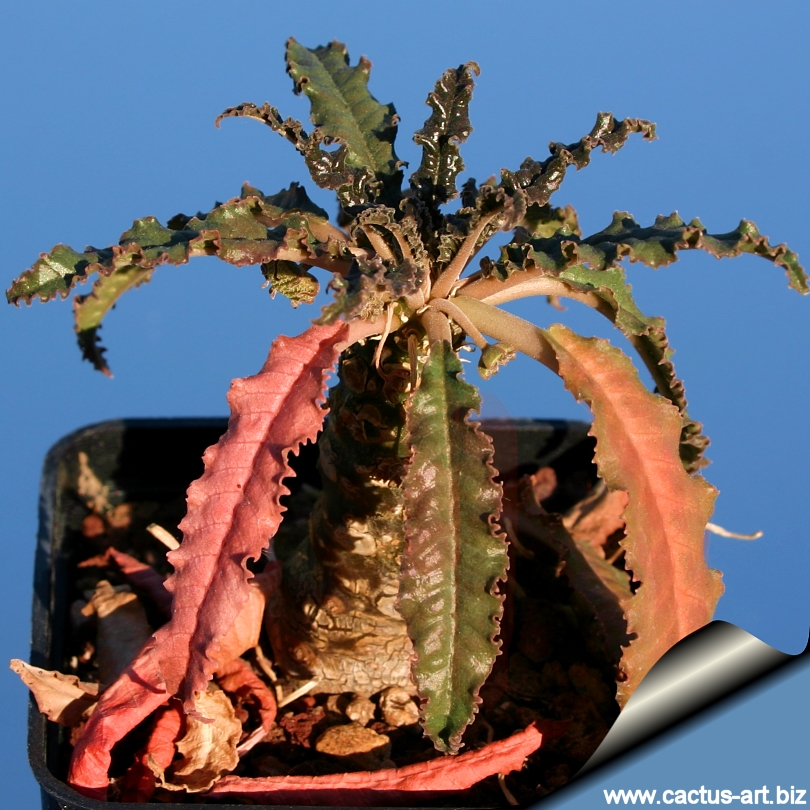
Leaves: Evergreen or
caducous,
at stems' tips, light green to grayish-green narrowly lanceolate to
broadly elliptical (sometime nearly
orbicular
or linear), 1-15 cm long,
0,5-4,5 cm wide, tip acute to shortly acuminate, or
obtuse to rounded.
Base attenuate to
cuneate or rounded. Margin rather ‘crinkly,’ ondulate
and crenate to subentire or
dentate.
Lateral
veins 3-15 pairs, Petiole
0,1-6 cm long, and relatively broad.
It has subpersistent to
caducous leaf stipules, about 0,5 to 10 mm long.
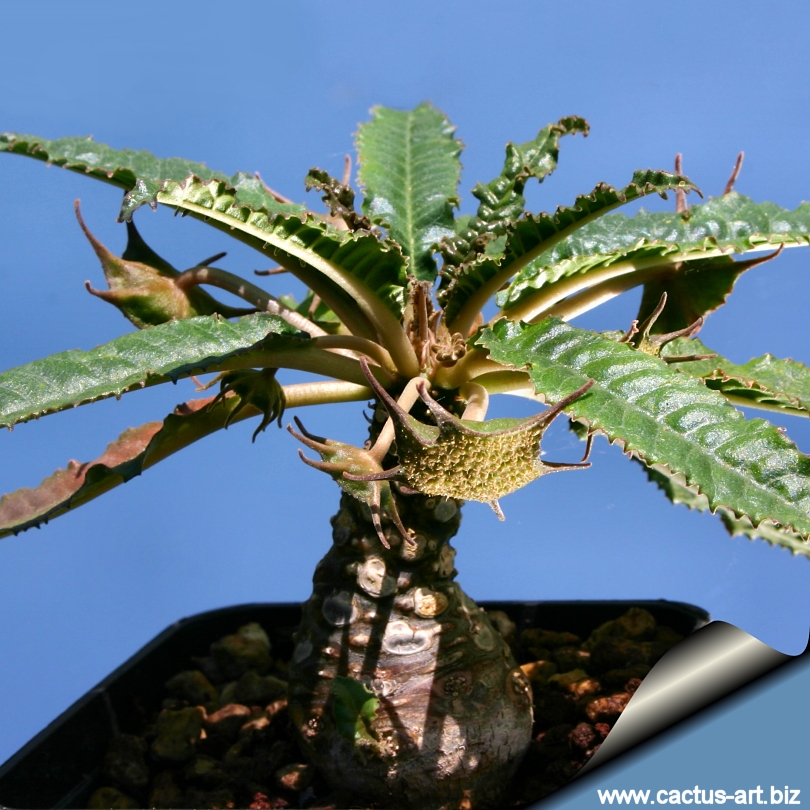
Flowers: It produces grayish or green (or orange/pinkish),
solitary, pedicellate, flower-like structures that are actually fruiting
bodies called hypanthodiums. This
inflorescence is a weird, horned, tentacle-like disc-shaped structure
that has given these plants the common name "Shield Flower."
The
"Shield" actually consists of a multitude of miniscule flowers. 0, 5-2
cm wide.
Fruit: The seed pods open explosively when ripe and send the seed
flying a considerable distance (up to 2 meters) -
similar to some Euphorbias.
If you intend to keep the seeds, care must be taken to catch them with a
piece of fabric or by other
means.
|
|
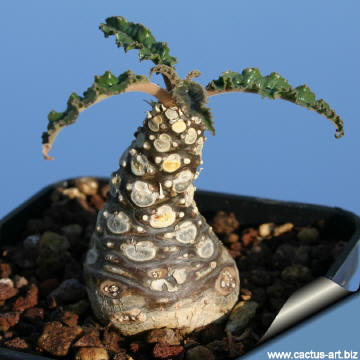
New leaves in spring at
growth resumption
after winter rest.
|
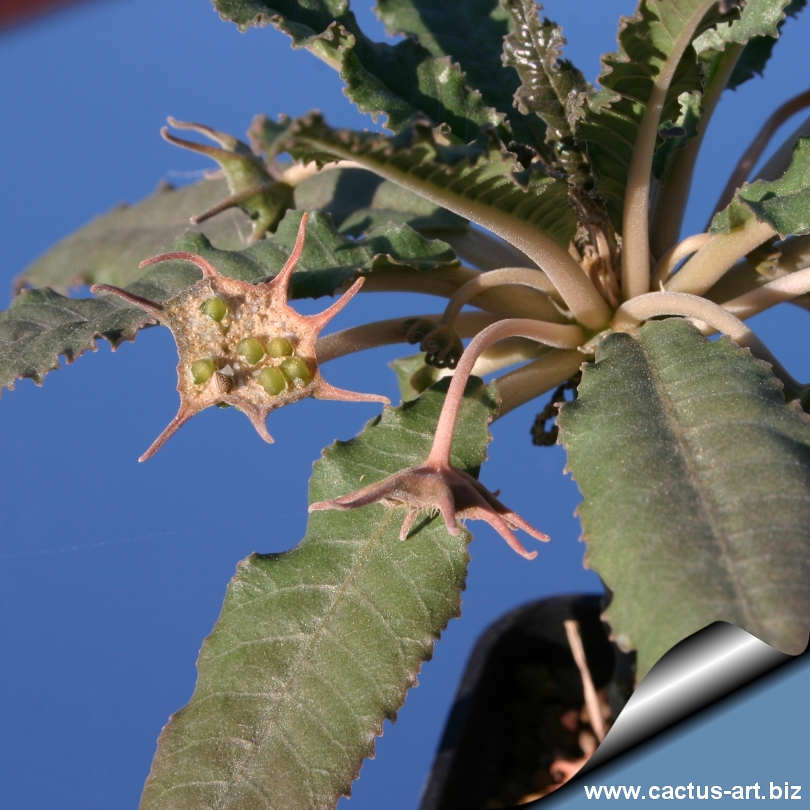
A "Shield Flower" with fruits. |
|
USE: Though in Oman the tubers of Dorstenia
foetida are cooked and eaten. We do not suggest plants for
consumption!
Culture: Dorstenia foetida
needs bright light or partial to full shade, with warm temperatures and a
well-drained soil mix that must not remain soggy for too long.
During the
growing season, the plants appreciate a fair amount of water but allow
the soil to dry slightly between watering, making sure that they never
dry out completely.
They have to be kept in a rather high air humidity.
They are fertilized once during the growing season with a balanced
fertilizer diluted to ½ the strength recommended on the label. During
the winter months they tend to go at least partially dormant and will
exhibit some leaf loss. During this period, they should be given very
little water.
Propagation:
Dorstenia foetida are usually propagated by seed. Seed germinate
readily at 21° C. They can also be propagated by cuttings.


|
|
Advertising
|
|
|
|
|
Family: Moraceae
(Also seen as member of the Urticaceae family) |
|
Scientific name: Dorstenia
sp. ( foetida form)
Dorstenia foetida
var. foetida (Forsskål) Schweinfurth
Bull. Herb. Boissier 4(app. 2): 120, 1896
Origin:
It is
native of a vast area, comprising Ethiopia, Somalia, Kenya, Tanzania,
Saudi Arabia, Yemen and Oman.
Habitat: Grows in
decidous and succulent bushland, open places, and on rock outcrops,
altitude 100-2100 m.
|
Synonyms:
- Kosaria foetida Forsskål 1775
(Basionym)
- Dorstenia crispa Engl.
- Dorstenia radiata Lam.
- Dorstenia phillipsiae Hook.f.
- Dorstenia arabica Hemsl.
- Dorstenia foetida subsp. lancifolia
(Rendle) Friis
- Dorstenia crispa var. lancifolia
Rendle
- Dorstenia crispa var. pachypoda
Chiov.
- Dorstenia foetida var. obovata (A.Rich.)
Schweinf
- Dorstenia obovata Hochst. ex
A.Rich.
- Kosaria obovata (A.Rich.)
Schweinf. ex Solmsa
|
|
|
|
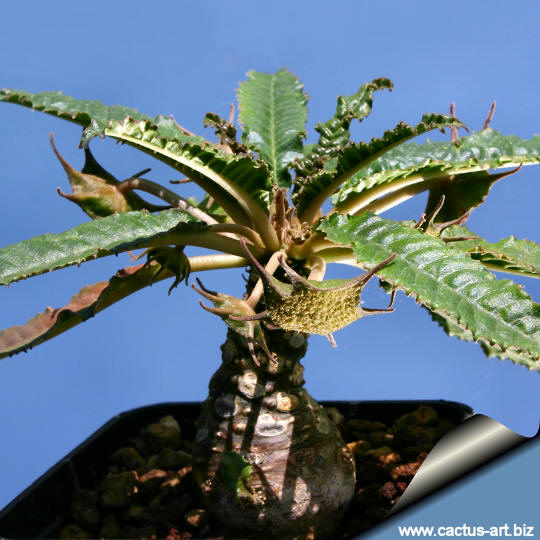
The inflorescence is a weird, horned, tentacle-like disc-shaped
structure called hypanthodium, that has given these plants the common
name "Shield Flower". The "Shield" actually consists of a multitude of
miniscule flowers.
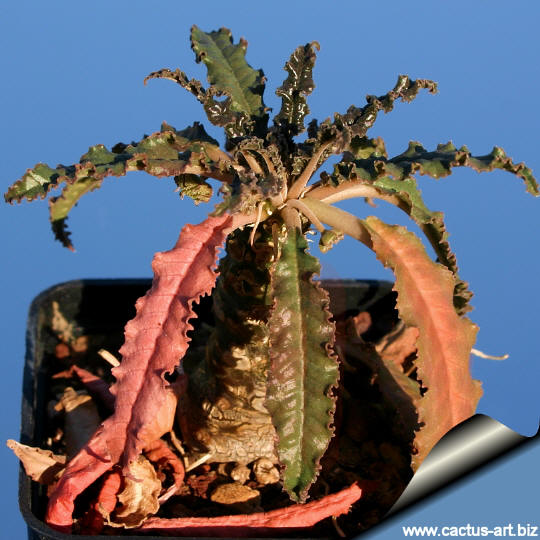
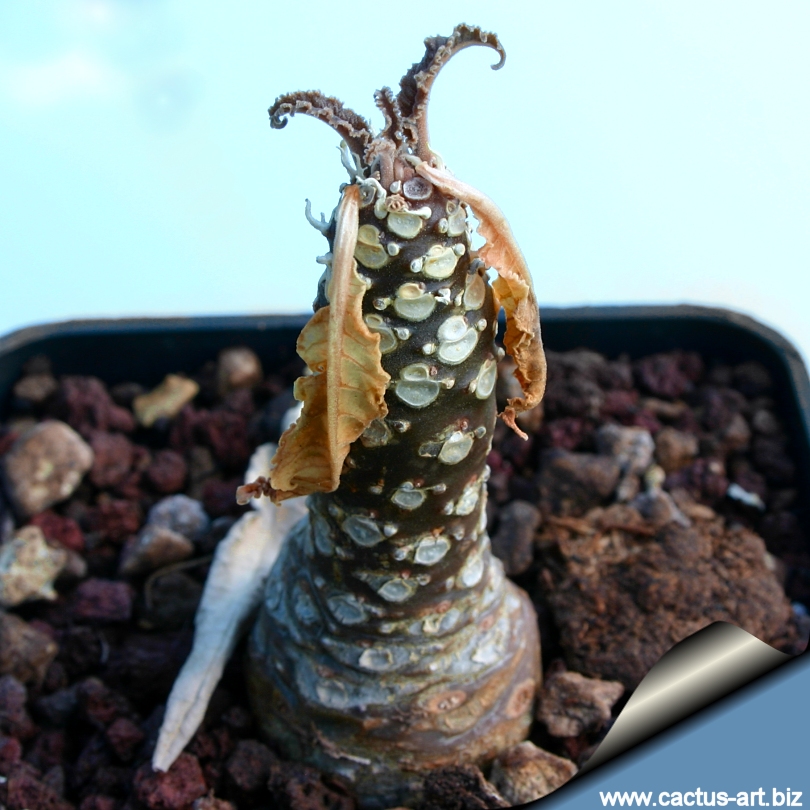
Autumn: the leaves start sheding
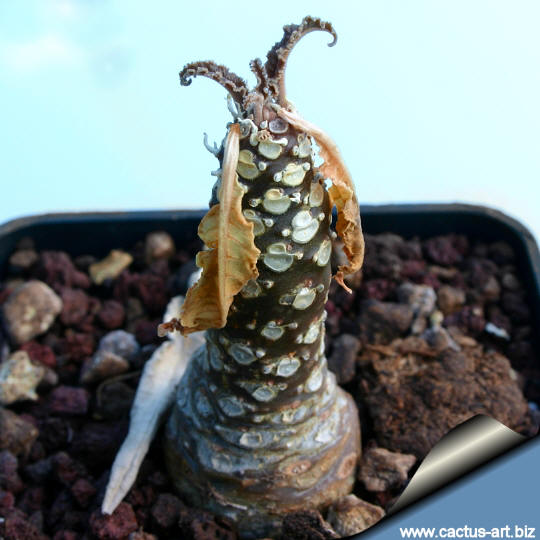
During the winter months they tend to go at least partially dormant, and
will exhibit some leaf loss.
|
|


 Cultivation
and Mail Sale
Cultivation
and Mail Sale