|

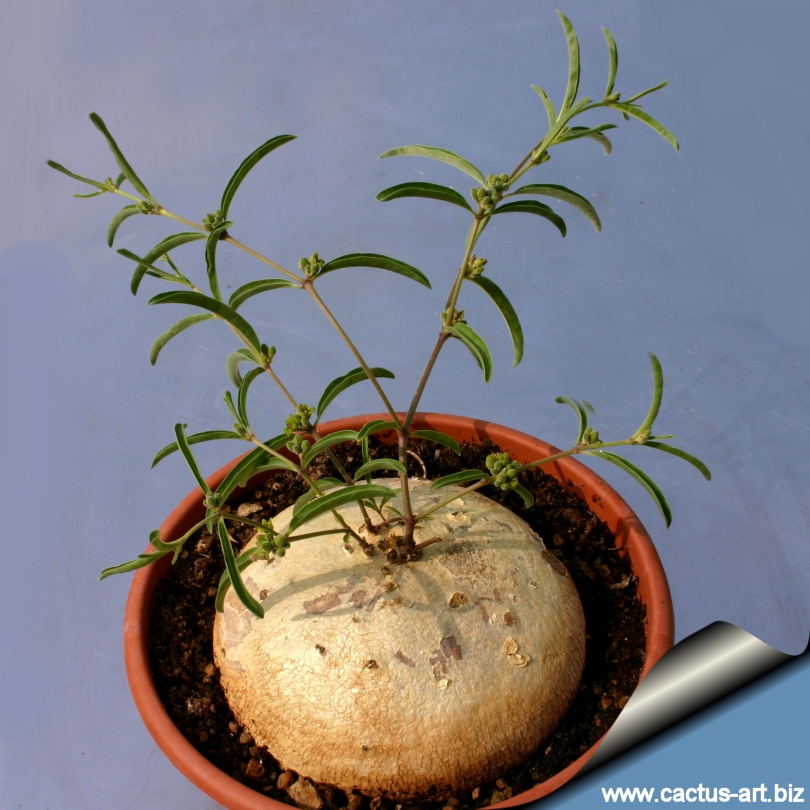
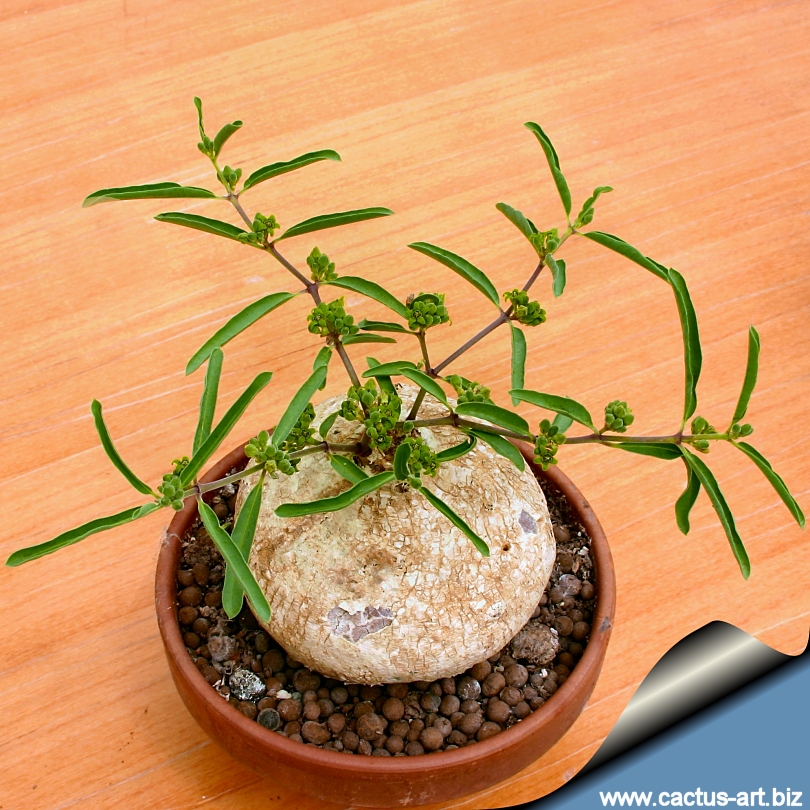
Raphionacme burkei
These are charming
plants, cool to those who like to collect them...
odd to others.
|
 |
Description: Small growing
caudiciform perennial herb producing trailing, vining shoots.
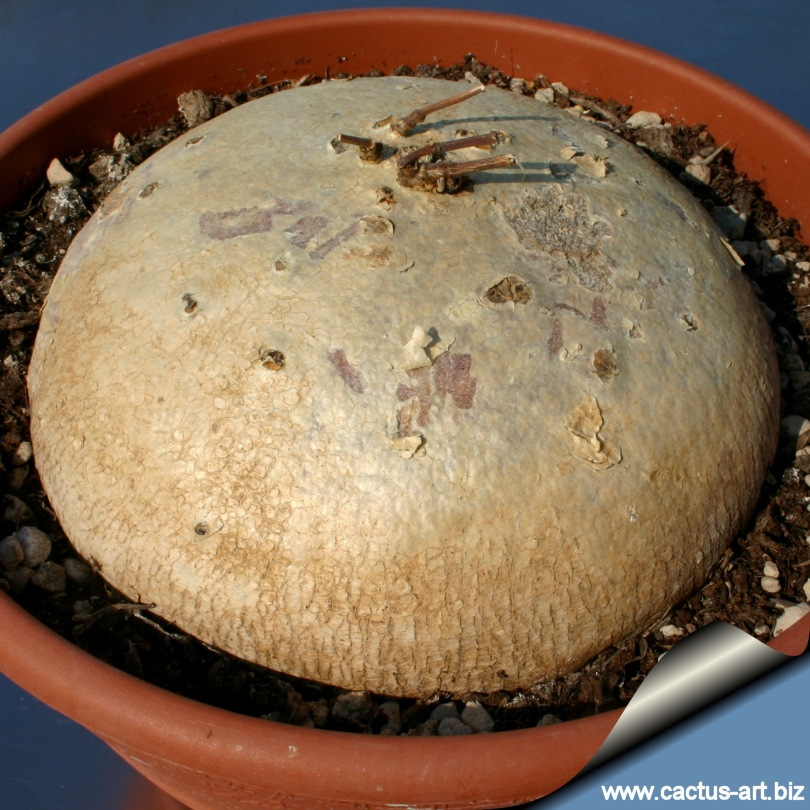
Caudex (Tuber): Big mostly spherical ± flattened, almost always
unbranched, smooth, above-ground. It might grow to 30 centimetres or
more
Stems: The stems (vines) are numerous, deciduous, semi-erect,
shrubby or partially climbing up to 45 centimetres (usually less),
scarcely pubescent.
Leaves: In well-spaced pairs; petiole 2-3 mm long, blades linear-lanceolate
to obovate, widest about middle, tapering equally to both ends, pointed,
up to 5 cm long X 1-1,5 cm wide, usually smaller. Acute, basally
tappering, margins ciliate, lower lamina face pubescent.
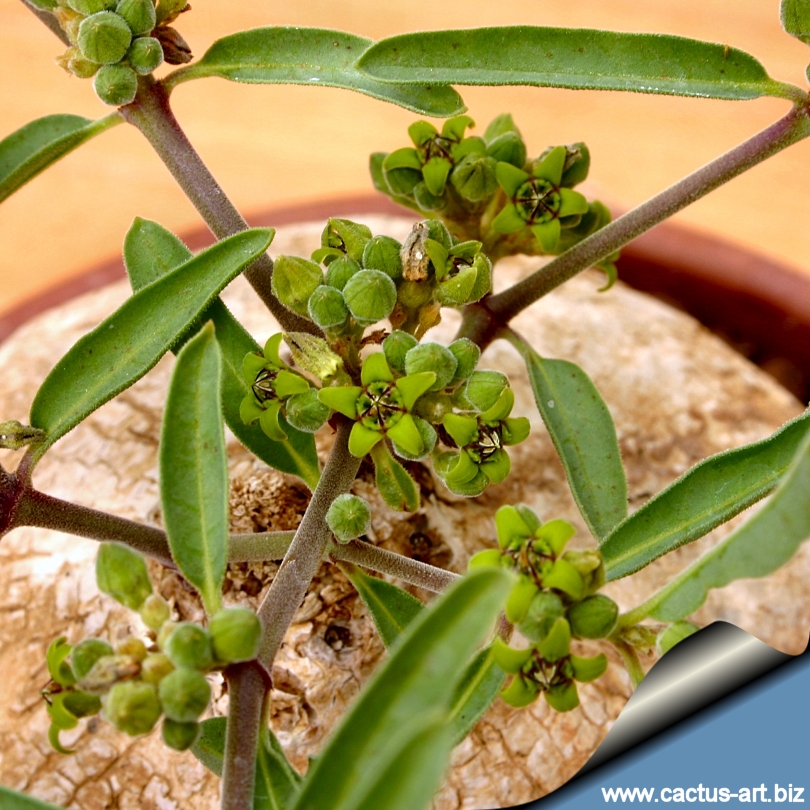
Flowers: Inflorescences lateral, almost from each node, sometimes
also between upper leaf-axils, on short stout stalk, densely
many-flowered, ±
globular. The flowers are deciduous, pale green star-shaped with a
purple centre, Ø
9 mm. Peduncle 1-2 mm long. Corolla lobes reflexed, narrowly triangular,
about 5 mm long, densely hairy below, hairless above.
Blooming season: Summer. |
|
Fruit: Solitary, thickly fusiform,
glabrous.fruit-halves slender, up to 15 cm long x 5 mm diam, tapering to
long point, often only one half developing.
This species is closely
related and form a complex to R. galpinii, R. velutina
and R. zeyheri. the contrastingly bicoloured corona is
significant for R. burkei.
Cultivation: In cultivation the plants are usually grown in semi
shade, with the tubers wholly or (preferably) partially exposed to
prevent scorching and rotting of the roots. This plant can take a good
deal of water during active growth and should be watered only when not
dormant. Keep dryish in winter. It should be
overwintered in the greenhouse at temperatures over 12°C (avoid
letting temperatures drop
lower than 5° C). Use a very draining but rich
soil. An error in cultivation may produce
unsightly holes in the tuber.
Reproduction: Can be reproduced both by cuttings and seeds.
|
|

 |
|
Family:
Asclepiadaceae (Apocynaceae)
(Milkweeds family)
Sub-family: Periplocoidae.
|
|
Scientific name: Raphionacme
burkei
Author: Nicholas Edward Brown Fl. Cap. (Harvey) 4: I.
537. (1907).
Origin: Southern Africa
Etymology: The name Raphionacme
is derived from the Greek words 'rhaphys', beet-root, and
'akme', sharpness, presumably describing the taste of the
tuberous roots.
|
Synonyms:
- Raphionacme velutina Schltr
- Raphionacme dinteri Schlechter 1910
- Raphiodacme pachyodon K. Schumann 1910
- Raphiodacme viridiflorum Turrill 1924
|
|

The Raphionacme has a swollen, water-storing stem (caudex)
and produce green leaves and shoots during the periods that
are favorable for growth, and live consuming the
water and food stored in the caudex during long dry spells.

Traditional uses:
Raphionacme burkei, is known to the bushmen as 'Bi'. It is a useful
plant that is particularly important as a source of water in the dry
months. It flourishes all year round, and is a major source of
water where a water source is not available. It's tuber is juicy, fibrose
and bitter. |
|