Home | E-mail | Photo gallery | Mail Sale Catalogue | Grafting Guestbook |  Dictionary |  Winter test | Links | Search

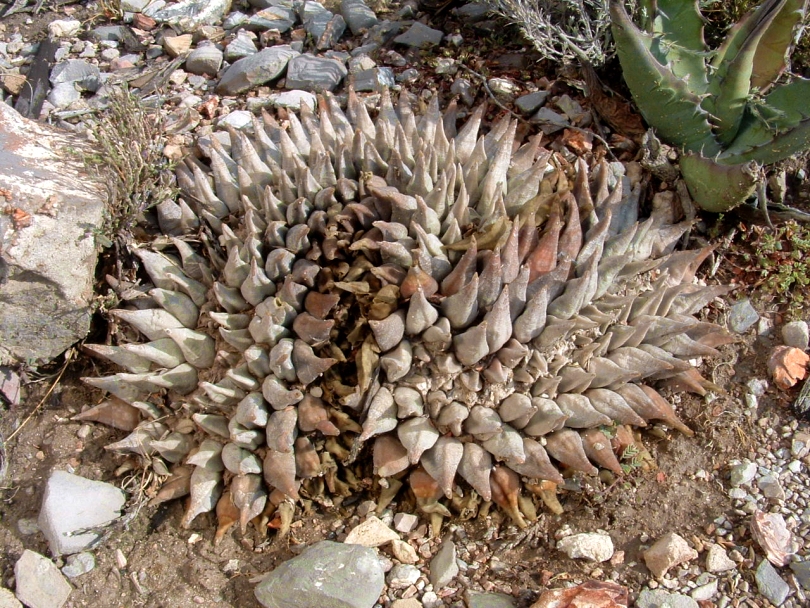
  Ariocarpus retusus forma cristata CACTUS ART
NURSERY

Cultivation and Mail Sale
of Cacti and Succulents.


Photo & © copyright by Jürgen Menzel
Ariocarpus retusus forma cristata in habitat.
This plant is a rarity every cactus impassioned would like to have.
The appeal lies in the peculiarly-shaped tubercles plus the challenge of growing it successfully.


Description: Ariocarpus retusus is the largest species of the genus characterised by long tubercles slightly projecting above ground level. The crested form is rarer than the normal plant, and it is particularly sought after by collectors.   Also this crest can get quite large making a spectacular specimen.

Stem: Grey, or blue-green, flattened 10-25cm thick.
Tubercles: Leaf-like, divergent, erect, basally compressed, usually becoming attenuate at the apices, convex or nearly flattened adaxially and often with shallow adaxial undulations or wrinkling, not fissured, 1.5-4cm long, 1-3.5cm wide, nearly as wide as long;
Areoles:
at the tips of the tubercles, rounded, 1-5mm in diameter.
Flowers: Diurnal 4-5cm in diameter., 2-4 2cm long; white to pink (or magenta), occasionally with reddish midribs,
Root: Swollen and very large tap root
Flowering time: October
Fruit: white, green, or rarely pinkish, 10-25mm long, 3-10mm in diameter.

Ariocarpus retusus is an extremely variable species. Also crested plants may be quite different one to each other.

Family: Cactaceae (Cactus Family)

Scientific name: Ariocarpus retusus Scheidweiler, (1838)
Pubblished in: Bull. Acad. Sci. Brux. 5: 492
forma cristata

Conservation status: Listed in CITES Appendix I
 

Common name: Living Rock, Seven Stars

Origin: Widely distributed from north of Saltillo, Coahuila southwards to San Luis Potosi, SLP, Also found occur in Tamaulipas , Zacatecas and Nuevo Leon.

Habitat: High Chihuahuan desert at altitudes of between 1300 and 2000 metres, on calcareous hillsides and occasionally gypsum plains. At lower altitudes (200 - 800m) of the Sierra Madre Oriental it is replaced by A. retusus ssp. trigonus.


Cultivation:
This species is slow growing but certainly not as slow as some other types of cacti, it is of easy culture in a well drained, non-organic, free-draining soil compost, with ample water during the growing season.  Use of a weak low-nitrogen fertilizer during the growing season can encourage growth. The main threat to their development is root rot. Ariocarpus should be kept dry whenever there is a threat of cold. The appearance of Ariocarpus can benefit greatly by watering the plants from the bottom. This practice will help to keep the “wool” on the top of the plant from becoming matted or discoloured. Need light shade to full sun. Frost Tolerance: Hardy to -10° C

Propagation: Cuttings, occasionally grafted.


Photo of conspecific taxa, varieties, forms and cultivars of Ariocarpus retusus.

Photo gallery: Alphabetical listing of Cactus and Succulent pictures published in this site.

Photo gallery Ariocarpus


A Special Thanks to all Those Who help us to make this web site
This plant description is based on research and personal experiences and is too short to provide a comprehensive coverage of the subject. Do you see an error in what is shown? Or do you know more about the species than we are showing? Your help is greatly appreciated. Why not send us an email with further information or photos so that we can correct or extend the information provided?

The photos in  this site are subject to copyright. Images may not be copied, downloaded, or used in any way without the expressed, written permission of CACTUS ART nursery and the original photographer.

Home | E-mail | Photo gallery | Mail Sale Catalogue | Grafting Guestbook | Dictionary |  Winter test | Links | Search