|
|
|
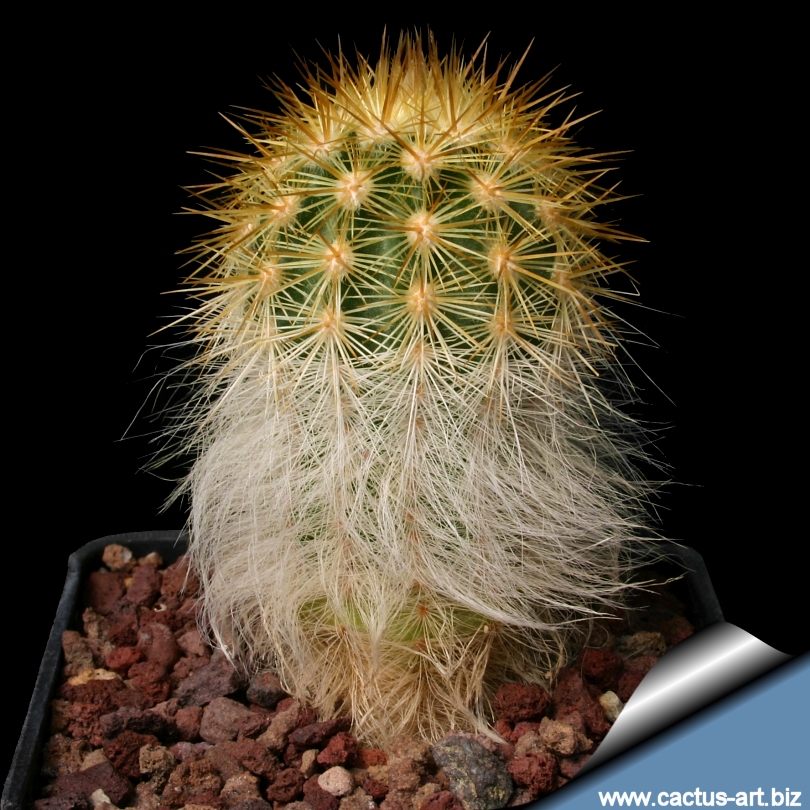
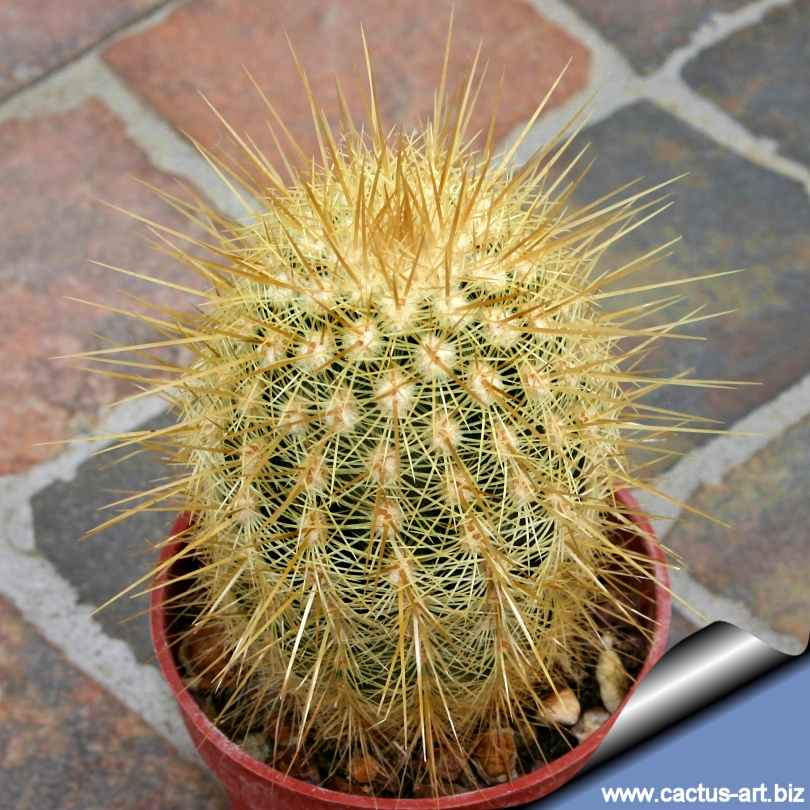
Echinocereus russanthus var.
neocapillus
This
species has an upright solitary stem with dense golden spines and
greenish flowers,
it is remarkable for its softly hairlike, not sharply spiny, seedlings.
|
|
|
|
 |
Description: This cactus is rather small in
size and usually solitary but can branch above and form small clusters about
15 cm wide.
Stem: Upright, cylindrical, pale to yellowish-green 6-8(-15) cm tall.
Each head is about 4 cm wide only.
Ribs: 12-18
Areoles: Oval to round, 3-5 mm long covered with whitish to
yellowish wool when young, becoming bare with age, except for a very
small tuft near where the flower is produced.
Spines: Mature specimens have dense golden needle-like spines obscuring the
stems, radiating in all directions, while the juvenile growth is marked
by approx 40 soft, flexible white hair-like spines 6-30 mm long.
persisting at base of old stems. Normal spines appear whent the stem is
about 2-5 cm tall.
Radial spines: 25-45 yellow or white (or light brown) spreading in all
direction.
Central spines: 5-11 heavier than radials spreading in all directions
from centre of the areole, yellow (or sometime whitish or light brown)
often with reddish tip. |
|
Flowers: It produces plenty of yellow-green (or greenish-brown) flowers 1,5-2,5cm in
diameter and they are fragrant. Well, if you think the smell of lemon is
fragrant that is.
Blooming season: The flowering period is about one month long
(Late march to early May) The flowers open again for 3-4 days after
closing at night
Fruit: Dry, greenish, round to oval, 10-15 mm long, 7-10 mm
across. They are covered with clusters of white spines, 20-25 in each
areole. mature fruit remain green, or turn dull purplish red, then split
longitudinally and quickly dry out.
Seeds: Finely papillate, black, 08-1,2 mm wide.
|
|
Advertising
|
|
|
|
|
Family:
Cactaceae (Cactus
Family) Echinocereus neocapillus (D.Weniger )W.Blum et M.Lange 1998
Scientific Name:
Echinocereus russanthus
var.
neocapillus
Origin: This cactus was originated from New Mexico near
Albuquerque.
Common English Names include: Golden spine edge-hog, Long haired
green flowered pitaya, Weninger's small flowerered hedhog cactus, Woolly
edgehog, goldspine edghog cactus.
Conservation status: Listed in
CITES Appendix II
Synonyms:
- Echinocereus chloranthus var. neocapillus Weniger
D. Weniger
Published in: Cact. Succ. J. (Los Angeles)
41: 39, fig. 4. 1969.
- Echinocereus chloranthus subsp. Neocapillus
- Echinocereus viridiflorus neocapillus
Cultivation: In culture
E. russanthus is without problems and regularly shows its
small purplish flowers if we provide an adequate winter
rest period. Very hardy for a cactus. But remember, the soil has
to by dry.
This plant tends to lose it's roots and shrink in the wintertime, but in
summertime needs more water. It is sensitive to overwatering (rot
prone) needs good drainage, Keep drier and cool in winter. Need full
sun; Very cold resistant hardy to -10° C or
less for short periods of time.
Propagation: Seeds or cutting (if available)
|
|
|
|
Photo of conspecific taxa,
varieties, forms and cultivars of
plants belonging to the
Echinocereus viridiflorus
complex.
E. russanthus
is part of the
E. viridiflorus compless that comprises a large number of
infraspecific
taxa, differing in various combinations of flower color, spine color,
number and thickness of central spines, and other characters, including
floral scent. Wherever such taxa are
sympatric they intergrade; all are freely interfertile in the
greenhouse. Among them:
-
E. viridiflorus var. viridiflorus: (Typical form)
With small stems and relatively pure yellow flowers, extends
from central New Mexico and the Texas Panhandle to South Dakota. (E.
viridiflorus var. robustior) is a more robust form but not
sufficiently differentiated and considered merely a local
variant of E. viridiflorus v. viridiflorus.
-
E. viridiflorus var. chloranthus (E. chloranthus) with the
most numerous central spines (five or more per areole), giving the
plants a bristly appearance, are often considered a separate species.
-
E.
viridiflorus var. russanthus (E. russanthus)
: Plants with a bristly appearance usually with reddish
or russet flowers. Yellow-spined plants may occur at high altitudes.
-
E. viridiflorus
var. cylindricus (E. chloranthus var.
Cylindricus) : The common morphotype at middle altitudes in
Texas and southeastern New Mexico has 0-2(-3) central spines.
-
E. viridiflorus var. correllii (E.
chloranthus var. Cylindricus "corellii") A poorly
defined, yellow-spined population near Marathon, Texas.
- E. viridiflorus var. neocapillus (E.
chloranthus var. neocapillus): Remarkable for its softly
hairy, not sharply spiny, seedlings.
- E. chloranthus subsp. rhyolithensis
Bristly red-spined plants from New Mexico.
Echinocereus viridiflorus in the broad
sense may prove
paraphyletic with respect to
E.
davisii, but they are
phenologically isolated, with E. davisii flowering
earlier and thus appearing reproductively isolated in the wild.

 |
|


 Cultivation
and Mail Sale
Cultivation
and Mail Sale