|
|
|
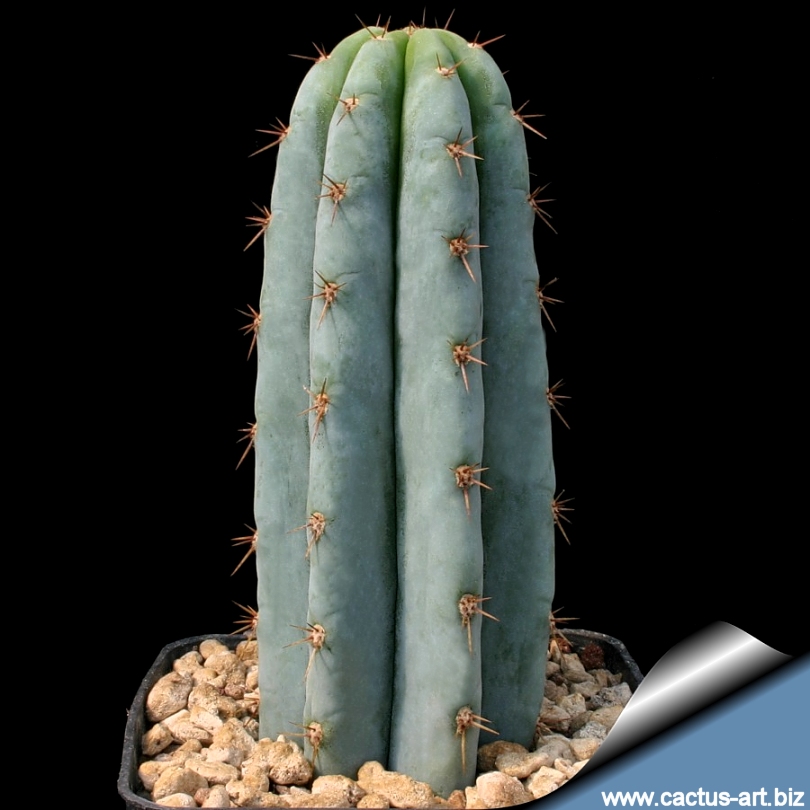
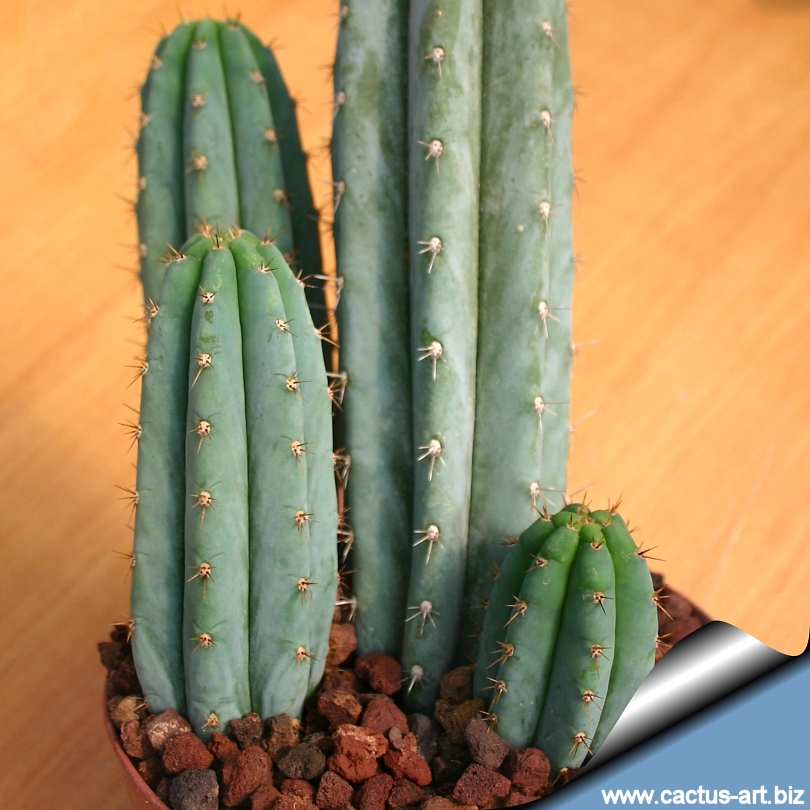
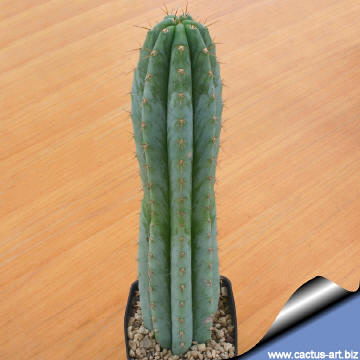
Trichocereus pachanoi has highly variable spines. Some stems have
essentially no spines, but others have as many as 3-7 yellow to brown
spines, up to 2 (or more) cm long. Time and again a spineless plant, after several
years of growth, has started producing spines. Like its
relatives, this
species is a quick grower and is reported to
grow up to 6m in height.
|
|
Growth Habits: Large,
multi-stemmed fast-growing columnar cactus. Forms a small tree 3 to 6
meters tall by 1,8 m spread, with several branches, usually extending
from the base.
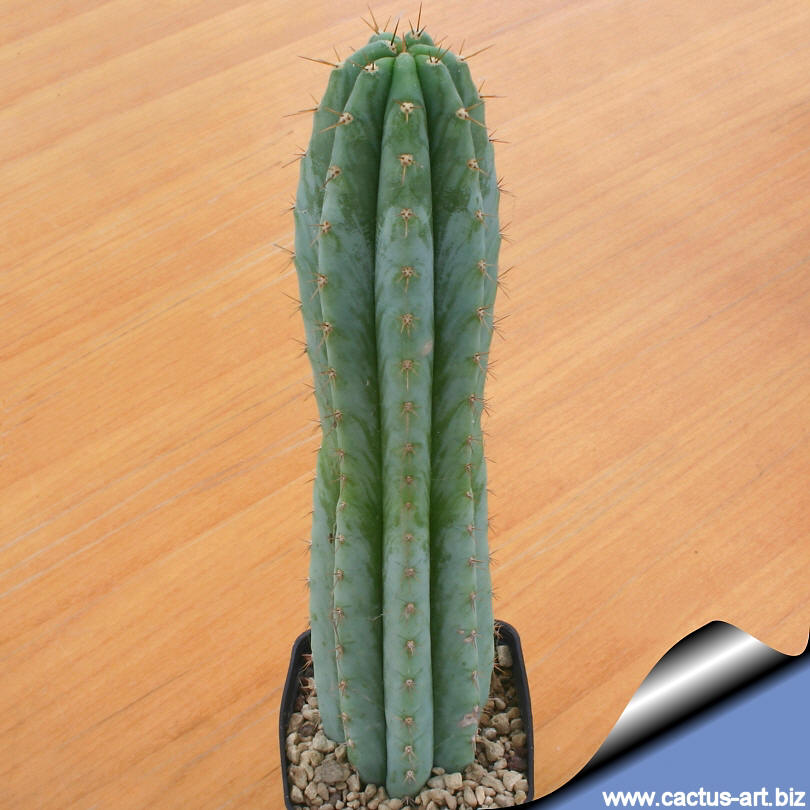
Stem: Upright columnar
and flexible, pale green to blue-green, slightly glaucous when young,
dark green in age. Up to 6 m tall, 6-15 cm in diameter.
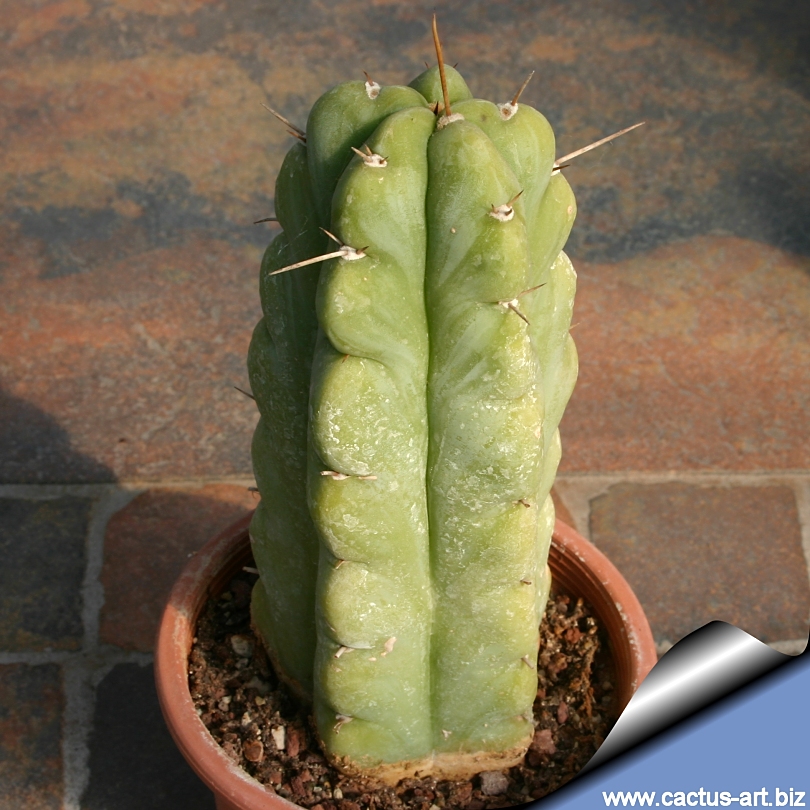
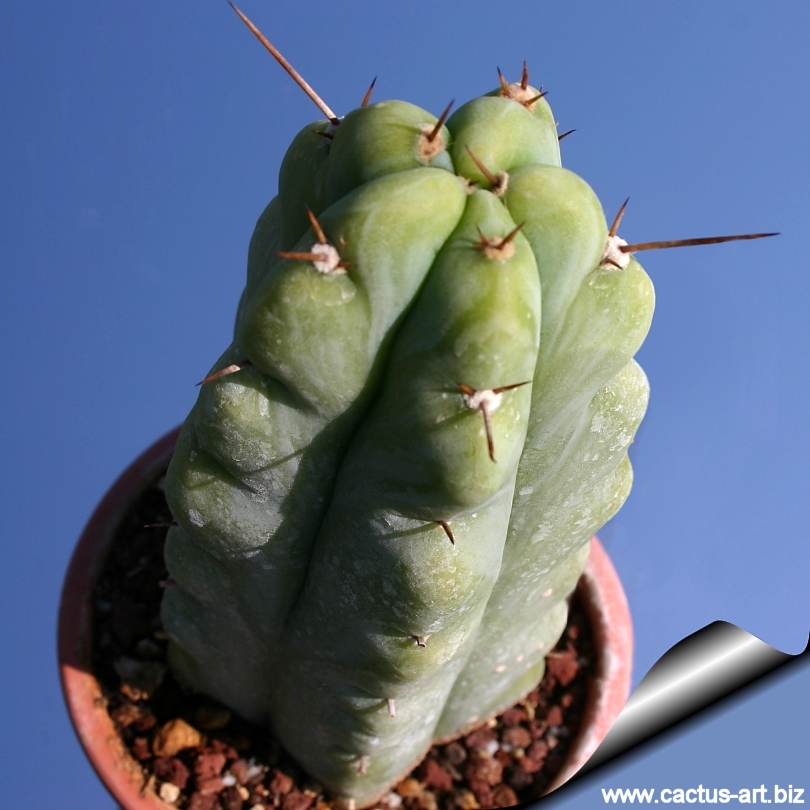
Ribs: 4-8, (usually 5-7)
broad at base, obtuse, rounded, with a deep horizontal depression above
the areole.
Areoles: Whitish, close
set.
Spines: Highly variable,
often wanting, when present few
(3
to 7),
unequal, the longest 1 to 2 cm. long, dark yellow to light brown.
Spines
are located at the nodes which are spaced evenly (approximately 2 cm
apart) along the ribs.
Flowers: Very large,
white,
night blooming and remaining open for
the following day, fragrant, up to 22 cm in diameter. They are very
showy. Inner perianth segments white, outer segments brik red, stamen
filaments greenish. In this species, the flowers buds are produced from
the spine clusters along the margins near the top of branches. The buds
are
pointed. Flowers tube,
and fruits are
covered with scales and black curled hairs.
Blooming time: July.
Fruit: Oblong, dark-green, 5-6 cm long, 3 cm in diameter.
Remarks:
The San Pedro cactus (Echinopsis
pachanoi,) is often
confused with its close relative, the Peruvian Torch cactus (Trichocereus
peruvianus)
which
contains
small quantities of mescaline, a hallucinogenic drug.
|
|
 |
 |
|
. |
|
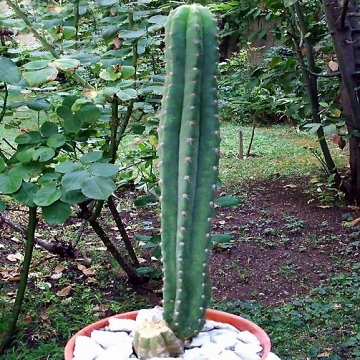
Photo &
© copyright
by Süleyman Demir Turkey
|
 |
|
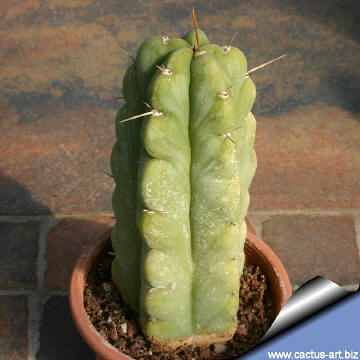
Photo of conspecific taxa, varieties, forms and
cultivars of Trichocereus pachanoi.
Advertising
|
|
|
|
|
Family:
Cactaceae (Cactus
Family) Trichocereus
pachanoi Britton & Rose
Published in: The Cactaceae 2 (1920) 134, t. 196.
Scientific name: Echinopsis pachanoi (Britton & Rose) H.
Friedrich & G. D. Rowley 1974
Common name: San Pedro (Peru, USA), Achuma (Bolivia)
Conservation status: Listed in
CITES appendix 2.
Synonyms: Cereus pachanoi (Britton & Rose) Werdermann
Origin: Mountains of Peru, Ecuador, Bolivia and northern
Argentina, between 1500m and 2700m elevation.
Subspontaneous in several South American and in some tropical countries
in other continents.
Habitat: It grows naturally in the high altitude, high
rainfall areas of the Andes, it can withstand temperatures far below
that of many other cacti.
|
|
|
|
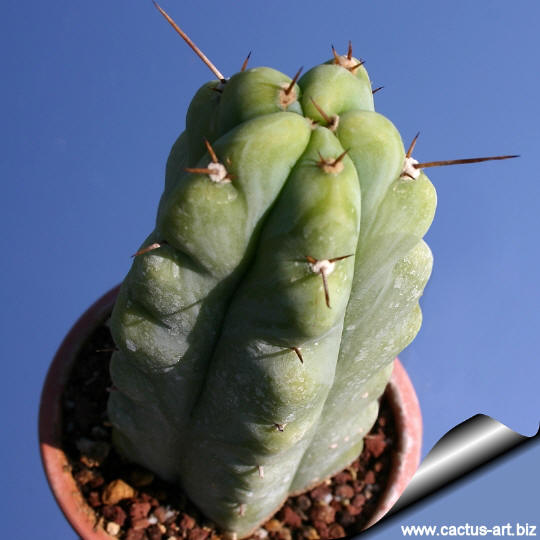
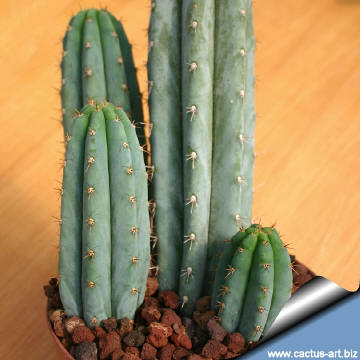
Trichocereus pachanoi will form several branches,
usually extending basally from beneath the soil level.
Cultivation:
Trichocereus pachanoi is very easy to grow and cold hardy as low as
-12°C (or less). It needs a fertile, well drained soil mix. Water the plants
well and allow them to dry before watering again. This species seems to
do better with a little more water than most cacti. In fact, its
cultivation requirements are really more like 'normal' plants than most
other cacti. During the growing season fertilize them monthly with a
balanced fertilizer
Sun Exposure: Outside
full sun, but during hot summers the cactus are subject to sun
burning, so grow them in light shade. Inside
they need bright light, and
some direct sun.. During winter months, put them in a cool luminous place
and encourage them to enter winter dormancy by withholding water and
fertiliser over the winter, as they will etiolate, or become thin, due to
lower levels of light. They are susceptible to fungal diseases if overwatered, but are not nearly as sensitive as many other cacti,
especially in warm weather. They tend characteristically towards black
rotted spots unless watering is moderate and only in hot weather.
If
kept damp through cold periods, they will invariably suffer.
T. pachanoi produces prodigious amounts of growth each year if kept well
fed and watered throughout the warmest months, particularly if it has
been acclimatised to accept full sun. Once this cactus is established
it can easily produce 30cm of growth every year.
Propagation:
By cutting or from seed. The seeds are quite easy to germinate and grow.
Their main requirements consist of high humidity levels, free-draining
soil mix, and enough water, light, and nutrition. USES:
-
Ornamentals: Often cultivated
for hedges and also planted as ornamental worldwide in tropical
climate gardens .
- Grafting stock: It is commonly
suggested as a universal grafting stock and is widely grown for this
purpose. It is by far one of the best and hardy root stocks for
smaller, slower, low-growing cacti often seen as the base stock in
photographs within numerous publications. Several others of the
Trichocereus species also work well as fast growing columnar stocks,
and have a good success rate for lasting a long time. Some forms of
T. bridgesii, T. peruvianus,
T.
spachianus and faster growing strains of T.
werdermannianus will also work well.
T. macrogonus and T. pasacana are often recommended for
colder climates and for grafting species of cold hardy scions. Scions
grafted on Trichocereus might initially take slightly longer to
begin their growth burst (when compared to other grafting stocks), but
usually have a very good life span of steady fast growth.
- Hallucinogenic drug:
The young stems are chopped because
of their alkaloid content and frequently sold in the markets in
Ecuador, north Peru and Bolivia. The indigenous people of the andes
recognize several “kinds” of San pedro, distinguished by the number of
ribs. Cacti with seve ribs are the least potent and most common. Cacti
with four ribs are rare , considedered the more potent and belived to
have special power because each rib correspond with one of the “four
winds”. The four winds and the four roads are supernatural powers
associated with the four cardinal directions. It is still used in
present days by shamans and folk healers. The use of this plant date
back to 3000 yeas ago.

 |
|


 Cultivation and
Mail Sale
Cultivation and
Mail Sale