|
|
|

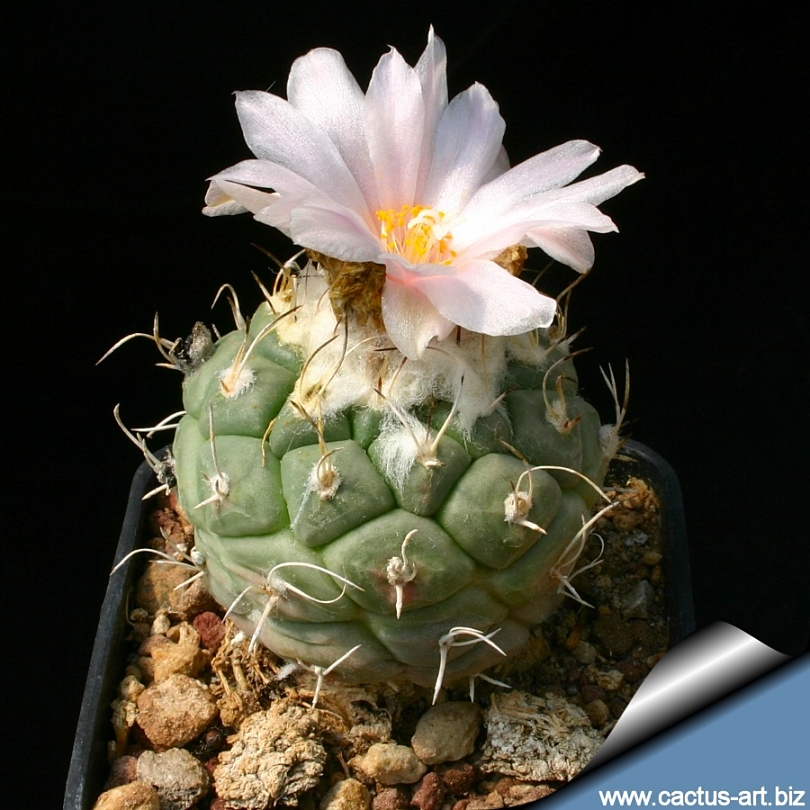
This is one of the most interesting Turbinicarpus, with very large
flowers. |
|
Description: Dwarfed usually solitary, flattened globose cactus (but
sometimes clusters with age) This turbinicarpus, one of the first
discovered, almost a century ago, has remained little known for a long
time, due to the difficulty, for a long period, to find it in the wild.
It specific name remember us that it resembles the genus Lophophora.
Stem: Greyish-green or bluish-green stem that doesn’t exceed
the diameter of (3) 4.5-5 (10 cm) by 4.5 high.
Root: Thick and delicate.
Tubercles: Organized in 12 spirals.
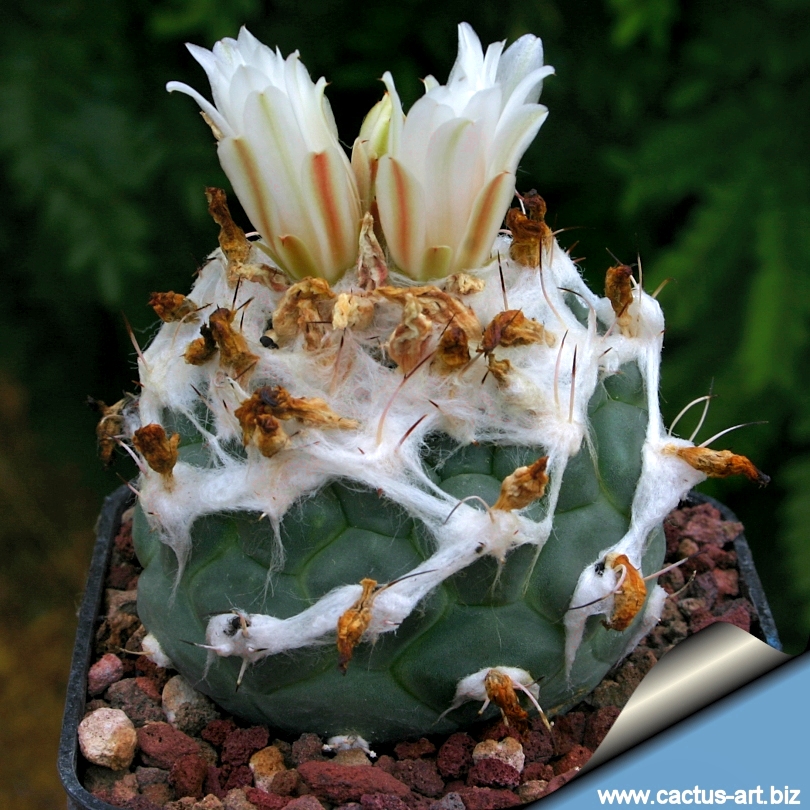
Areoles: Very pronounced, woolly, later
naked. With the age, the areoles become woollier and can get to
completely transform the aspect of the plant.
Spines: 3 to 5 spreading, thin, ± rigid, (even though there are
populations with 2 or even 6 spines per areole), mostly 5-8 mm long,
black-tipped brownish-grey.
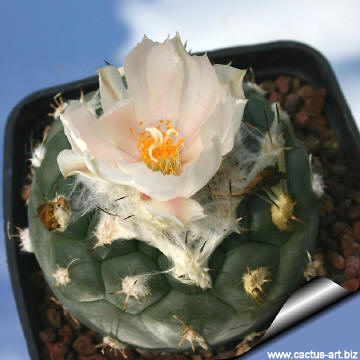
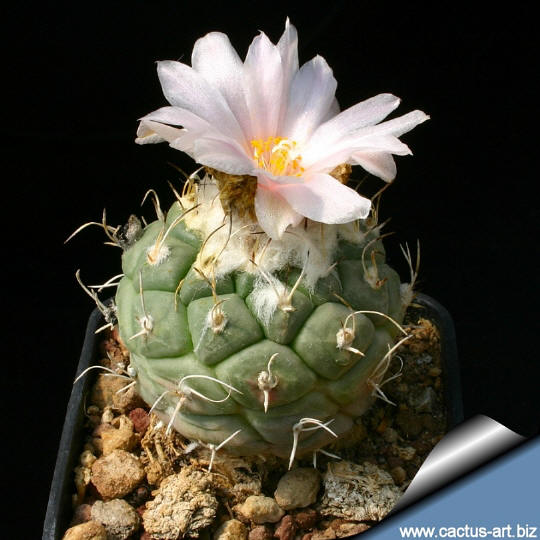
Flower: Usually rather large and white with a
pinkish tinge, 3.5-5 cm in diameter. They are developed from the
new very woolly areoles in the apex of the plant. It has scarcely
irritable stamens, straight but thin, with a low insertion of the
primary filaments, while in all the other species, (including the
Gymnocactus and Viereckii Series) the insertion is high and the stamens
are very irritable. This indicates that this species has some primitive
characters. Anthers yellow/orange. Stigmas white.
|
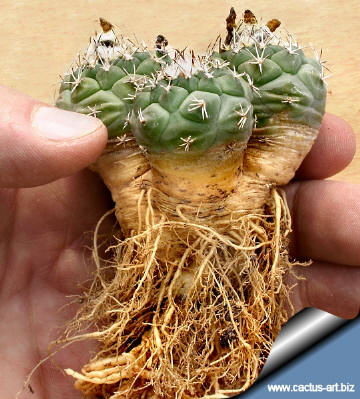 |
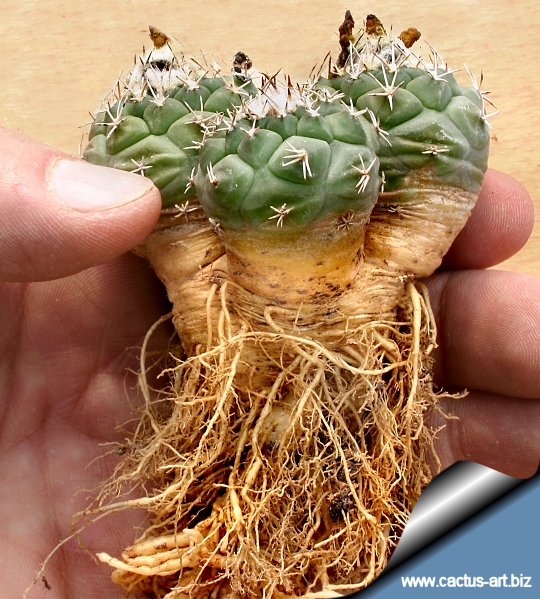
T. lophophoroides has a very
swollen and delicate
rootstock connected to the stem by a thick (not constricted)
neck. |
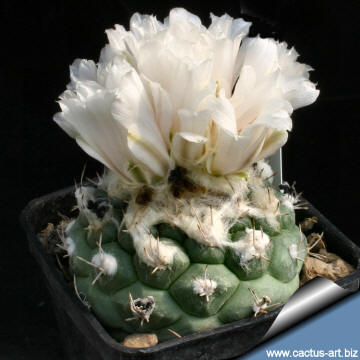
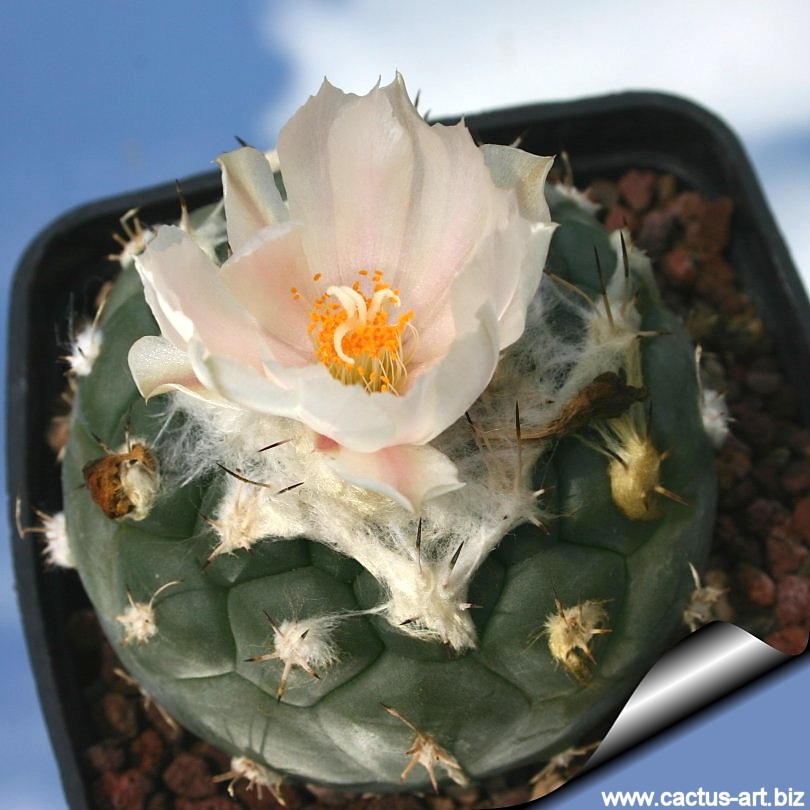
Flowers are
large and white with a
pinkish tinge |
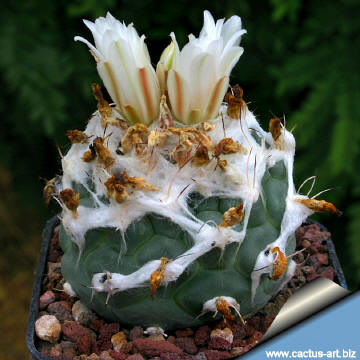
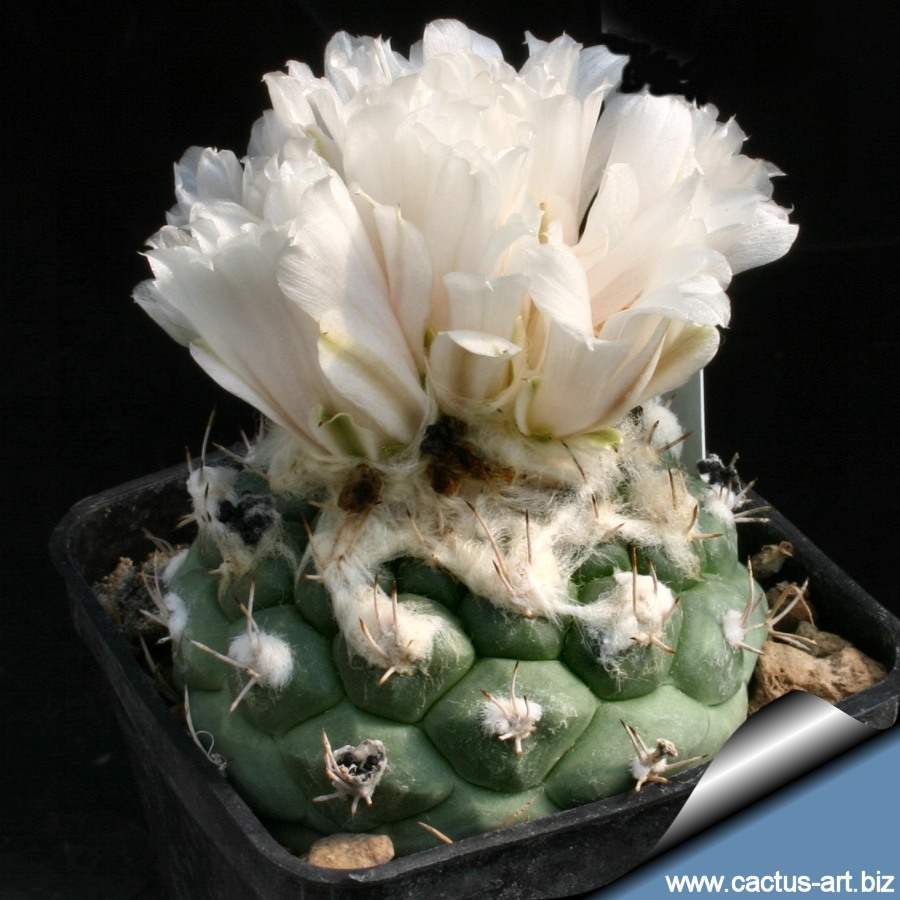
The white crown will offset the flowers.
|
|
Cultivation: It’s a plant adapted to a
specific type of soil and quite prone to rot especially after the first
flowering. A 10 -30% of natural gypsum could be added to a very well
drained soil. Watering should be rather infrequent, but abundant, so
that the soil becomes completely soaked. Careful watering away
from the body of the plant will allow the areoles to keep their wool.
The fact that the plant retracts into the soil and assume a grey-green
colouring between watering, is perfectly natural and doesn’t cause any
damage. Keep dry in winter or when night temperatures remain below 10°
C, it is hardy to -4°C for a short period. Assure a good ventilation.
Exposures: Full sun where it obtains a natural-looking flat, or part
sun.
Propagation: Seeds,
which has good powers of germination, or from shoots which are grafted.
|
|
Photo of conspecific taxa, varieties, forms and
cultivars of Turbinicarpus lophophoroides:
Advertising
|
|
|
|
|
|
|
Family:
Cactaceae (Cactus
Family)
Scientific name: Turbinicarpus lophophoroides (Werdermann) F. Buxbaum
& Backeberg
Published in: in Jahrbuch Deutsche
Kakteengesellschaft 1937 :27
(Often misspelled "lophophorioides")
Conservation status: Listed in
CITES appendix I
Origin: Mexico, San Louis de Potosì, situated between the
counties of Ciudad del Maiz on the north, and Cerritos-Villa Juarez on
the west and Rio Verde on the south, at an altitude between 800 and 1150
m above sea level.
Ecology and habitat: It
is found in several populations varying from a few individuals up to
several thousands of specimens in sparse grassland with herbs, or very
open woodland and open land with several opuntias, the plants grow not
hidden in crevices on sloping terrains, but are located on deep, salty
plains with mostly gypsum soil, that are seasonally flooded with great
concentration of salts and pH that can in some areas exceed 9.
Plant retract heavily into the ground during the dry season, so much
that they can disappear until the following rains don’t bring them to
their original dimension and make them reappear on the surface.
The type of environment where this taxon
lives, allows insects to visit many flowers, since the plants are not
hidden in crevices on sloping terrains and the flowers are very visible,
so the essential mechanisms used by the other Turbinicarpus sensu
stricto species are not necessary. Also, the T. lophophoroides
populations, are, if left undisturbed, relatively prolific, in fact they
are not linked to a particularly impervious and hostile environment
(from the water availability point of view), like that of the majority
of the other turbinicarpi, in fact T. lophophoroides is found in
numerous populations located on deep and horizontal ground.
Basionym: Thelocactus lophophoroides
Werderm.
Pubblished in: Kakteenkunde 1934 : 176-177
Synonyms:
- Strombocactus lophophoroides
(Werderm.) F.Knuth
in Kaktus-ABC, 356
(Backeberg & F. Knuth, 1935).
- Toumeya lophophoroides (Werderm.)
H.Bravo-H. & W.T.Marshall
in Saguaroland Bull. 1956
:119 (Bravo-Helia & Marshall, 1956).
- Neolloydia lophophoroides (Werderm.)
E.F.Anderson
in Bradleya 4 : 1-28 (Anderson, 1986).
- Pediocactus lophophoroides (Werderm.)
Halda
in Acta Mus. Richnov. 5 (1) : 21 (1998).
Turbinicarpus lophophoroides forms an
aggregate of taxa with the following:
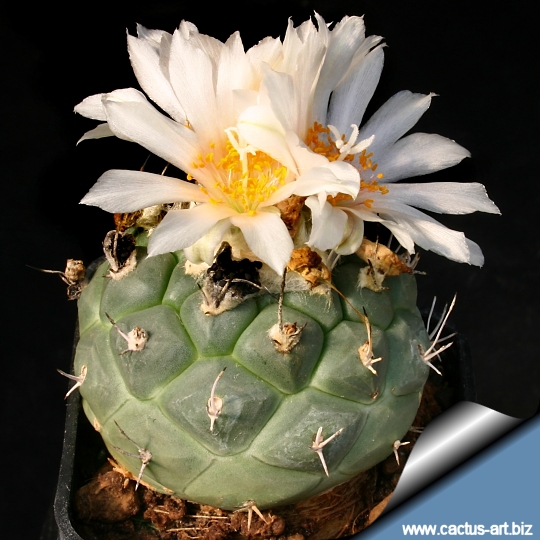
T.
lophophoroides (Las Tablas)
|
|
|
|


|
|


 Cultivation and Mail Sale