Home | E-mail | Photo gallery | Mail Sale Catalogue | Grafting Guestbook | Dictionary |  Winter test | Links | Search

      Euphorbia obesa ssp. symmetrica

CACTUS ART
NURSERY

Cultivation and Mail Sale
of Cacti and Succulents.


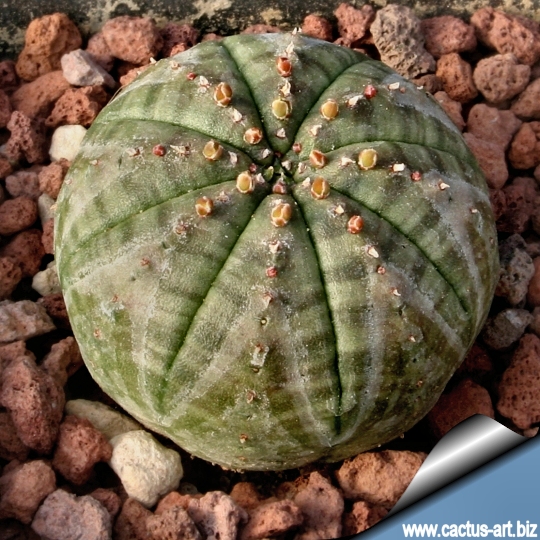
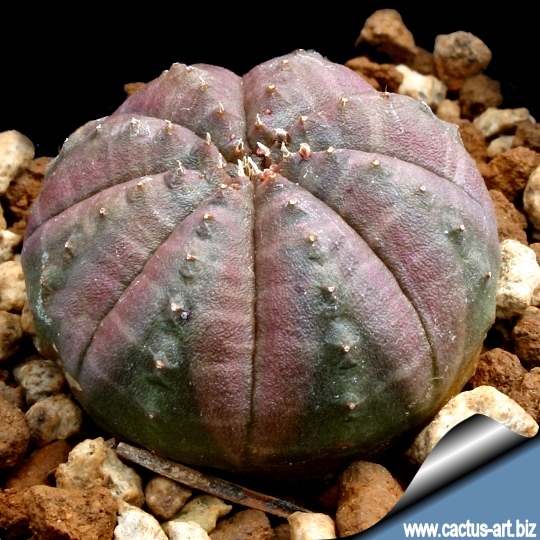
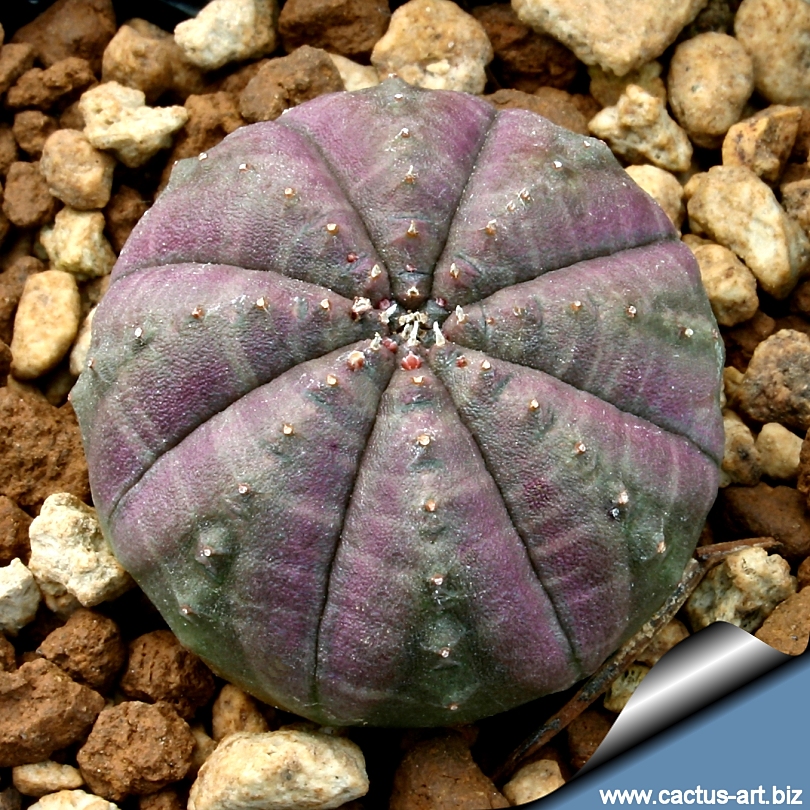
Euphorbia symmetrica is a beautifully flattened sphere with horizontal purplish banding and very similar to Euphorbia Obesa. Unusual in cultivation it is still rare to find.

Description: This plant can look nearly identical to Euphorbia obesa, but rounder, flatter and not growing as tall (dimension up to 6 cm , 8 cm diameter; 8 to 10-sided) It has usually more, somewhat different, markings. The flowers are also more numerous with several from each point of origin, it has as well a distinctive long taproot.


Cultivation: Like a sunny position. It does best in a mineral soil, good drainage is essential. Water sparingly during the summer months and keep dry in winter. It is a slow growing long lived plant and once established, it will be content in its position and with its soil for years. It can tolerate moderate shade, and a plant that has been growing in shade should be slowly hardened off before placing it in full sun as the plant will be severely scorched if moved too suddenly from shade into sun.
It is propagated from seed sown during spring or summer. Flowering can be achieved within 5-8 years.

Photo of conspecific taxa, varieties, forms and cultivars of Euphorbia obesa.



Photo gallery: Alphabetical listing of Cactus and Succulent pictures published in this site.

Photo gallery EUPHORBIA

Family: Euphorbiaceae

Scientific name: Euphorbia obesa ssp. symmetrica (A.C.White, R.A.Dyer & B.Sloane) G.D.Rowley 1998

Synonym: Euphorbia  symmetrica

Origin: South Africa (Cape Province: Willowmore, Beaufort W.)

Taxonomical notes: Euphorbia symmetrica became a subspecies under Euphorbia obesa. These species are closely related and for an outsider its very difficult to distinguish them. Even better would be to place them as a variety instead of a subspecies because at many places intermediate populations can be found. A definite population consists of a collection of variable forms. The difference between populations is the frequency of the appearance in which these forms do occur. So can it be be that two individuals of two different populations look very similar and also, two plants of the same population can look very different. However when you are looking at the whole population, you can see the difference of the population with another one.


A Special Thanks to all Those Who help us to make this web site
This plant description is based on research and personal experiences and is too short to provide a comprehensive coverage of the subject. Do you see an error in what is shown? Or do you know more about the species than we are showing? Your help is greatly appreciated. Why not send us an email with further information or photos so that we can correct or extend the information provided?

The photos in  this site are subject to copyright. Images may not be copied, downloaded, or used in any way without the expressed, written permission of CACTUS ART nursery and the original photographer.

Home | E-mail | Photo gallery | Mail Sale Catalogue | Grafting Guestbook | Dictionary |  Winter test | Links | Search