|
|
|
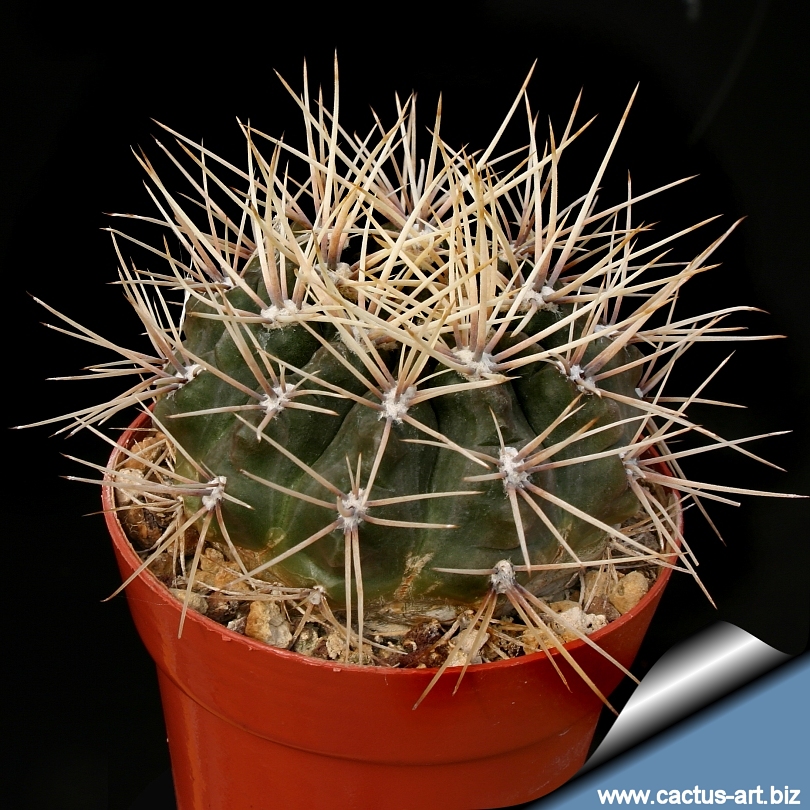
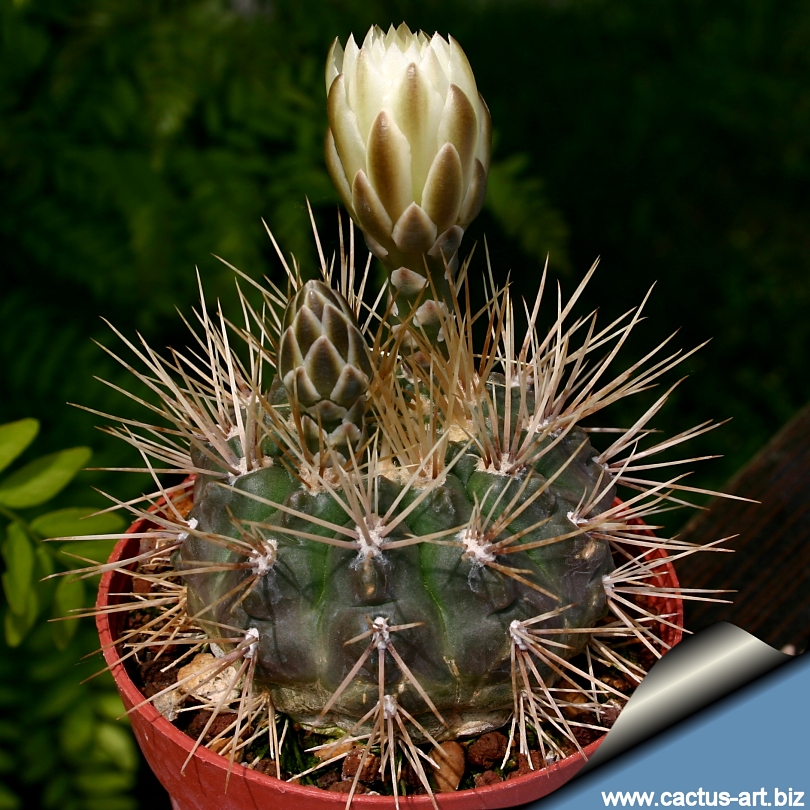
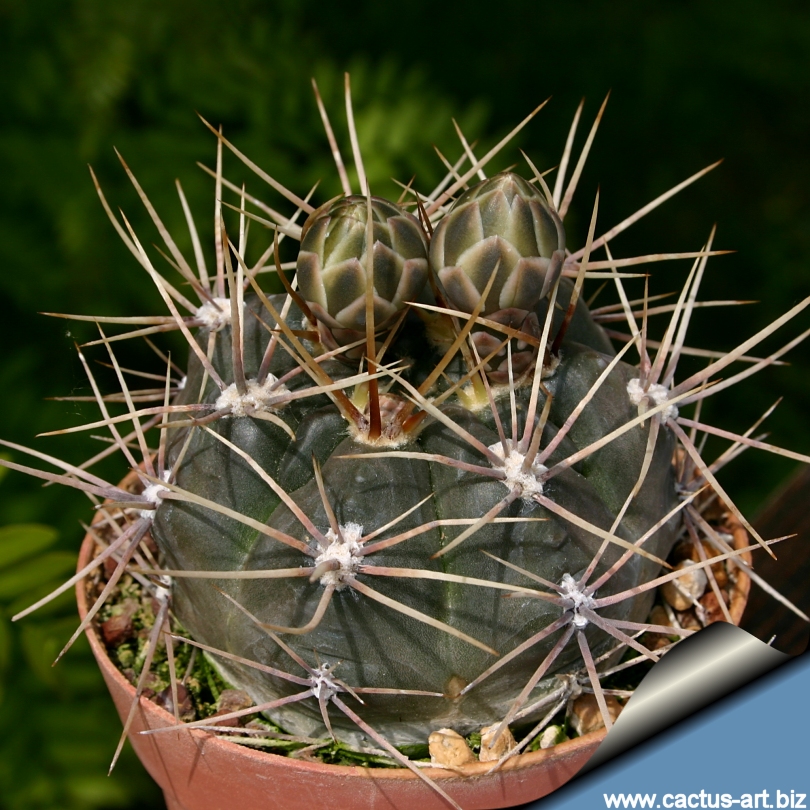
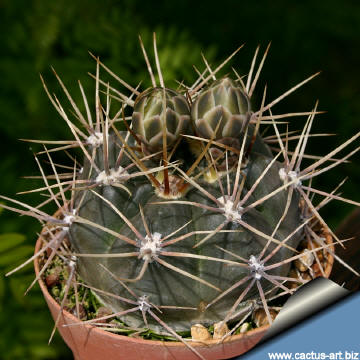
This variety is easily recognized by the very dark olive-green body and
the strong, more numerous, longer, overlapping, spines that are white
with a darker base.
|
|
Description: Solitary cactus. Usually larger
than the typical gibbosum.
Stem: Deep olive-green to almost black, flat to almost
spherical, 3-5(-10) cm tall, up to 12 cm in diameter, the apex is
slightly woolly.
Ribs: 10-16 straight, divided in well distinct, angular ribs.
Areoles: Whitish-grey,
elongated.
Radial spines: 7-10 (-12) 25-35 mm, strong, long, erect,
overlapping, pastel-white (but also yellow or black), with a darker
(reddish or brownish) base when young, that becomes whitish-grey as they
age.
Central spines: 0-2 very similar to the radials.
Flowers:
Infundibuliform
in the nearest periphery just around the apex, 45-60 mm
long, 60-65 in diameter.
Tepals ivory white with a brownish mid rib or
occasionally reddish.
Blooming season: Will flower without a distinct
resting period.
Fruit:
Globose or
fusiform, 20-40
mm long green with white bordered scale.
|
 |
 |
|
Cultivation:
This plant is a summer
grower and pretty easy to cultivate. Water and fertilize moderately in
summer. It requires excellent drainage. Make sure that soil gets the
chance to dry out in between waterings. During cold weather periods
keep rather dry, but it can handle excessive water to little water.
Best
for half-shade but it grows well in full sun and full shade, too (but in
full sun it turns an uneven brownish red colour).
Frost Tolerance: Hardy down to -12° to -32° C.
Propagation: Mainly through seeds.
Photo of conspecific taxa, varieties, forms and
cultivars of plants belonging to the
Gymnocalycium gibbosum
complex
(This
Taxon
has lots of synonyms
(
like many other Gymnocalyciums)
whit several controversial varieties and subspecies and comprises a multitude of different forms, but where each form
is linked to others by populations of plants with intermediate
characteristics):
|
|
Advertising
|
|
|
|
|
Family:
Cactaceae (Cactus
Family)
Conservation status: Listed in
CITES appendix 2.
Scientific name: Gymnocalycium
gibbosum var. nobile (K. Schumann) Y. Ito, nom. inval. (Art.
33.1)
Published in Cacti 1952: 88,1952 =
reductum
Common Name: Black Chin Cactus
Origin &
habitat: This species is distributed in the mountains of
Argentina of up to Patagonia .
Synonyms:
- Echinocactus gibbosus var. nobile K.Schum. 1898
- Gymnocalycium reductum (Link)
Pfeiffer ex Mittler,
Published in: Taschenbuch fuer Cactusliebhaber 2ed.: 48 + 124, 1844
- Gymnocalycium nobile n. n.
Published in: Gymnocalyciums :66
(1978) =
reductum
- Gymnocalycium gibbosum v. nobilis (Haworth) Borg
|
|
|
|
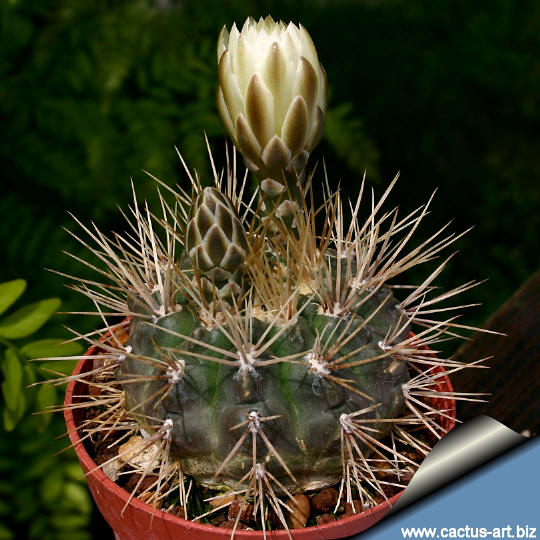
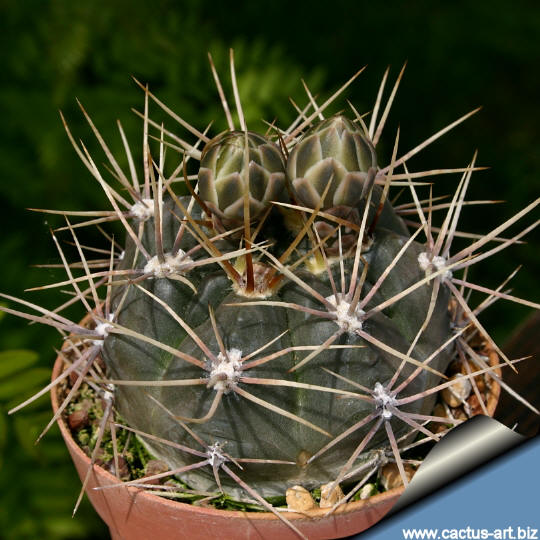
The density of spines is quite variable from one individual to another.

 |
|


 Cultivation
and Mail Sale
Cultivation
and Mail Sale