Home | E-mail | Photo gallery | Mail Sale Catalogue | Grafting Guestbook | Dictionary |  Winter test | Links | Search

  Lobivia saltensis
(Syn: Echinopsis saltensis )
CACTUS ART
NURSERY

Cultivation and Mail Sale
of Cacti and Succulents.


Lobivia saltensis
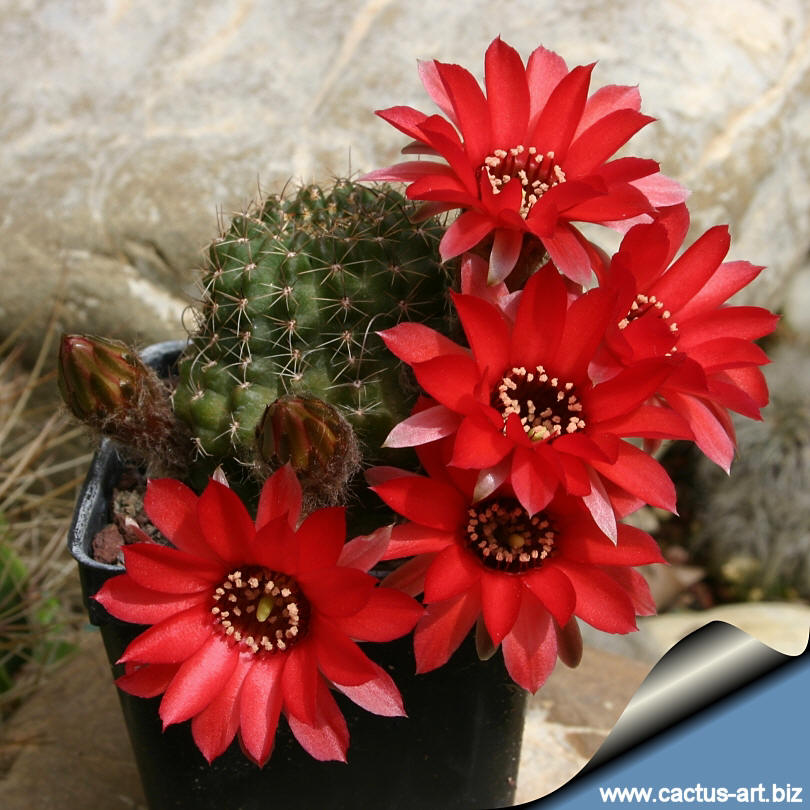
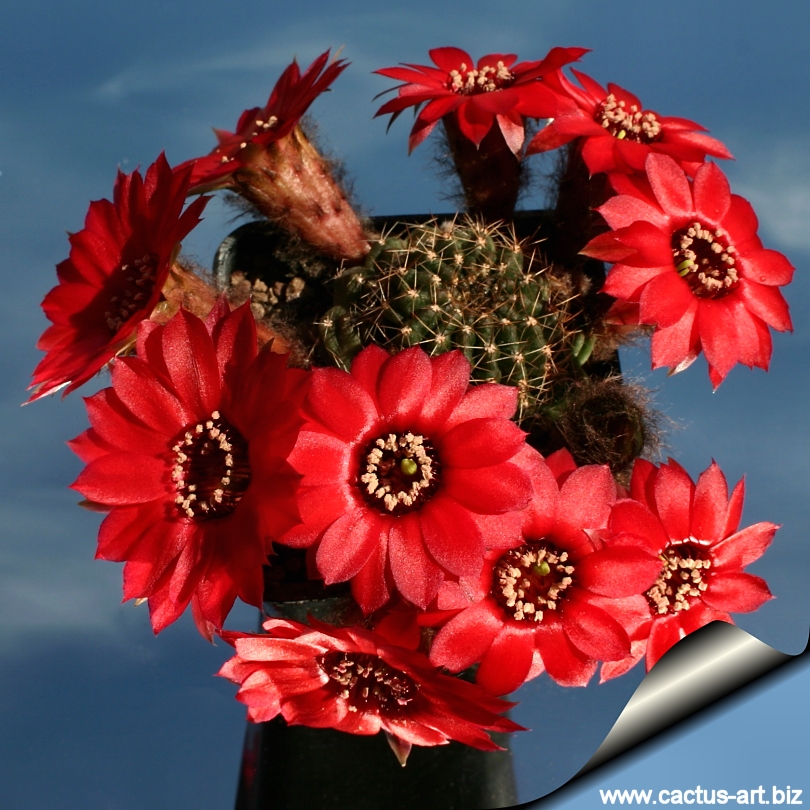
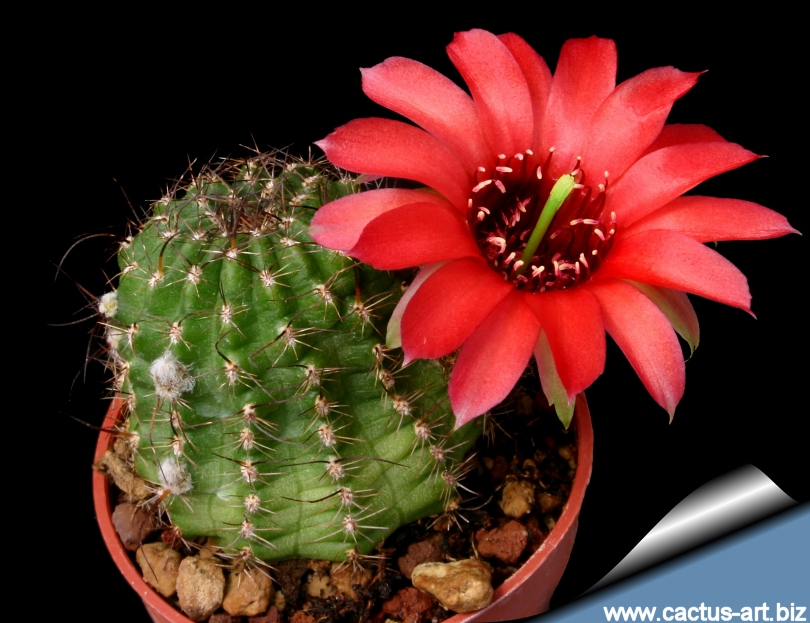
Big rich red flowers.
 

L. saltensis is a very interesting but variable species with several forms and variety.

Description: Small cactus, usually solitary, or heavily clustering.
Stem: Flattish, egg-shaped or skightly elongated, up to 12 cm tall, 9 cm in diameter, bright green to dark green or almost black.
Areoles: 5-7 mm apart.
Ribs: 17-18.
Root: Tap root.
Radial spines: 12-14 Thin, reddish.
Central spines: 1-4, whisker-like, twisted, asymmetrical, more or less long, interlaced up and in disorder curved up to 3 cm long. The length of spines greatly depends on sun exposure and plant's age.
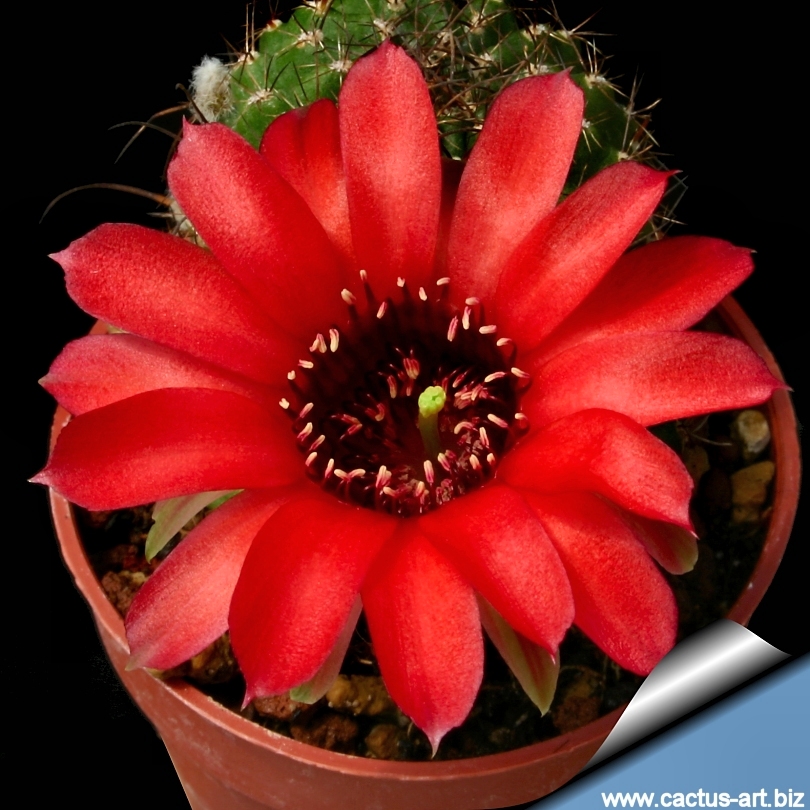
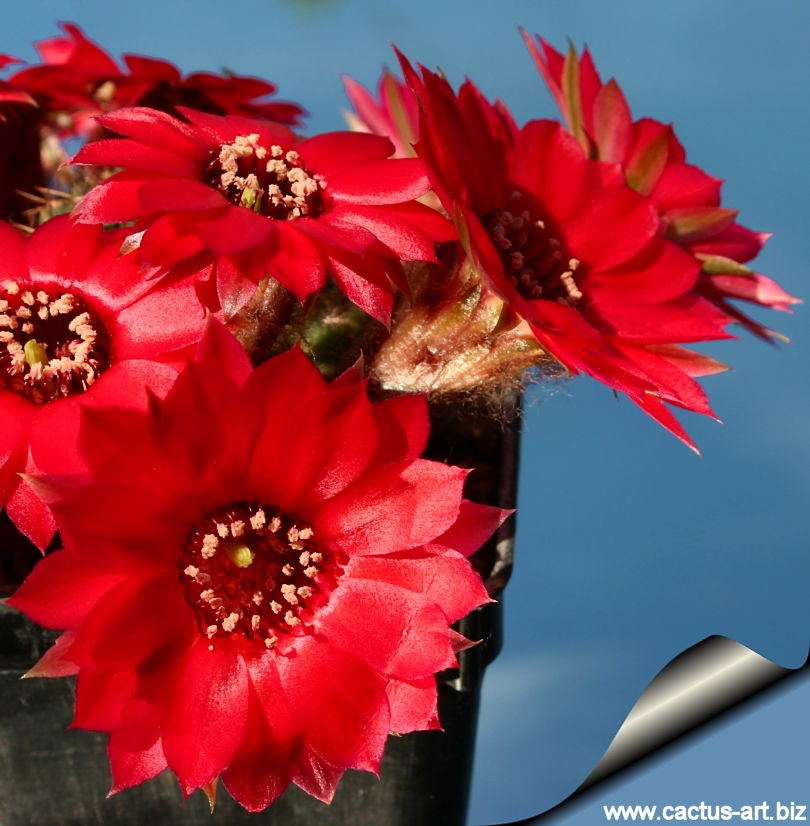
Flowers: Pretty, shining, small up to 5 cm long, unscented, somewhat bell-shaped-bulgy, dark orange-red or crimson that appears almost black when starting to open. The stamen's filaments are dark red, and bear cream-white contrasting anthers. The stigma lobes are greenish.
Blooming season (Europe): The greater part of flowers appears in spring in the first flowering, but the plant can erratically produce some flowers in summer too.
Fruit:
Globular, 5 mm in diameter, with little brown wool, up-drying.
Seed: Globular, small grained.

There are a number of controversial varieties of this highly variable cactus species, but not all are universally recognized. Some authorities recognize the following varieties.

L. saltensis var. saltensis Plants with the relatively short petals and dark-coloured Stamens. Origin between Tucuman and Salta ( from Alemania to close to Cafayate).
L. saltensis var. multicostata
The plant of t
his population are similar to Lobivia saItensis, however with 20 and more ribs, closer spaced Areoles and therefore also closer, broom-like Spination. Flower and fruit are alike. Origin: Cuesta de Lajar.
L. saltensis var. pseudocachensis Only a few cm small, clumping green bodies, with a long carrot root. Ribs about 14 straight. The plants in this population are quite variable and comprises both individuals with long central spines and individuals with short radial spines without central (They have respectively named by Backeberg L. emmae and L. emmae var. brevispina) The flower is 4-6 cm long and broad, light red to carmine coloured. The fruit and seed are similar to those of the other Varieties. Origin: Escoype.
L. saltensis var. nealeana This plant has usually somewhat larger solitary body  than the near var. pseudocachensis, sometimes also with long, curved Central-spines, the red blooms are more spread and rarely yellow too. The fruit and seed are similar to those of the other Varieties.

L. saltensis var. zapallarensis
This is the smallest form from the Sierra Zapallar it has only9-11 sharp-edged ribs, the epidermis is black-green, often also violet coloured with red to orange flowers, the fruit is more oval, however otherwise nearly like Lobivia saltensis


Photo of conspecific taxa, varieties, forms and cultivars of Lobivia (Echinopsis) saltensis.


Family: Cactaceae (Cactus Family)


Lobivia saltensis (Speg.) Br. et R.,
The Cactaceae; descriptions and illustrations of plants of the cactus family 3: 53, f. 70, 1922

Accepted Scientific name:  Echinopsis saltensis Spegazzini
Cact. Plat.Tent. 1905

Origin Tucumán, Salta, nothern Argentina

Conservation status: Listed in CITES appendix 2.

Synonyms:
  • Echinopsis cachensis Spegazzini 1905
    = Lobivia cachensis (Spegazzini) Britton & Rose 1922
  • Lobivia nealeana Backeberg
    In: Bl. f. K. 1934
    = Hymenorebutia nealeana (Backeberg) Buining 1939
    = Echinopsis nealeana (Backeberg) H. Friedrich 1974
    = Echinopsis saltaensis var. nealeana (Backeberg) J. G. Lambert 1998
    = Lobivia saltensis var. nealeana (Backeb.) Rausch,1977
  • Lobivia pseudocachensis Backeberg
    In:
    Bl. f. K. 1934
    = Hymenorebutia pseudocachensis
    (Backeberg) Buining 1939
    = Echinopsis pseudocachensis (Backeberg) H. Friedrich 1974
    = Echinopsis saltaensis var. pseudocachensis (Backeberg) J. G. Lambert 1998
    = Echinopsis saltaensis var. pseudocachensis
    (Backeberg) Rausch comb. nov.
    In: The Cactaceae 1922
    = Lobivia pseudocachensis var. cinnabarina Backbg.
    Kakt. ABC. 1935
    = Lobivia pseudocachensis var. sanguinea Backbg.
    Kakt. ABC. 1935
  • Lobivia emmae Backeberg
    In: The Spine 1948
    = Lobivia emmae var. brevispina Backeberg
    In: The Spine 1948
  • Lobivia saltensis var stilowiana (Backeb.) Rausch,1977
  • Lobivia saltensis var. multicostata Rausch
    K. u. a. S. 1977
  • Lobivia saltensis var. schreiteri (Castell.) Rausch,1977
  • Lobivia saltensis var. zapallarensis Rausch var. nov.

Cultivation: It is a summer-growing species that offers no cultivation difficulty.  Water regularly in summer (but do not over-water).  It needs good drainage and very porous soil.  Keep rather dry in winter. Feed with a high potassium fertilizer  in summer. It is quite frost resistant if kept dry (hardy to  -5° C) Outside full sun or afternoon shade, inside it needs bright light, and some direct sun.

Propagation: Direct sow after last frost. (seldom produces offsets)


Photo gallery: Alphabetical listing of Cactus and Succulent pictures published in this site.

Photo gallery LOBIVIA


A Special Thanks to all Those Who help us to make this web site
This plant description is based on research and personal experiences and is too short to provide a comprehensive coverage of the subject. Do you see an error in what is shown? Or do you know more about the species than we are showing? Your help is greatly appreciated. Why not send us an email with further information or photos so that we can correct or extend the information provided?

The photos in  this site are subject to copyright. Images may not be copied, downloaded, or used in any way without the expressed, written permission of CACTUS ART nursery and the original photographer.

Home | E-mail | Photo gallery | Mail Sale Catalogue | Grafting Guestbook | Dictionary |  Winter test | Links | Search