|
|
|
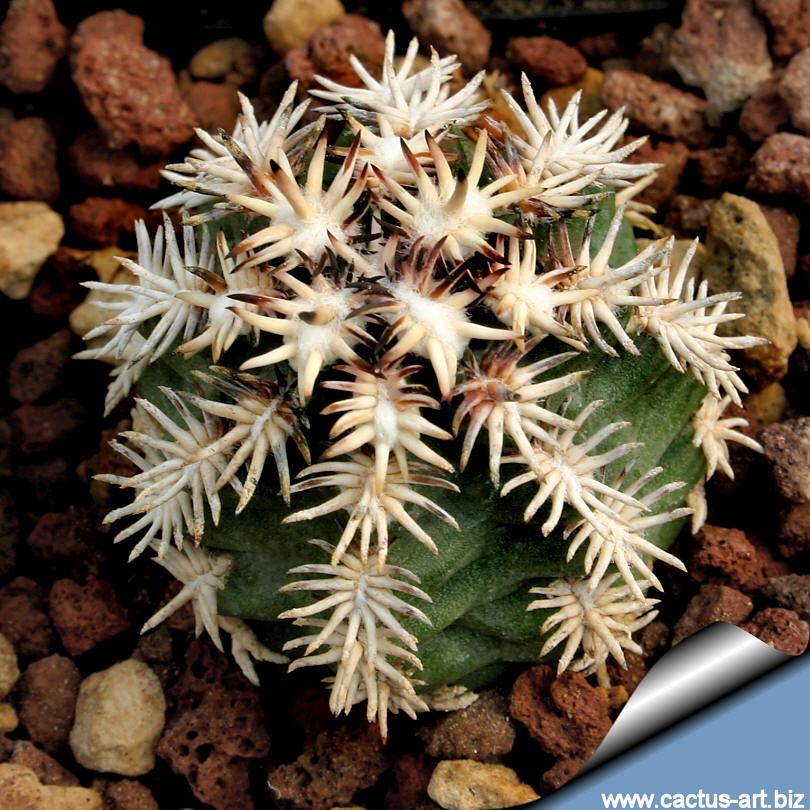
This is the short spined form of
E. davisii. It is very
beautiful and still rare in cultivation.
|
|
Description:
This is the rare and
beautiful short spined form of E. davisii. This
plant has an unique and unmistakable appearance and is considered by
many among the nicest cactus cultivars.
The standard E. davisii is the
tiniest Echinocereus species, plants are extremely diminutive and mostly
subterranean
(geophytes), usually do not
offset.
Stem:
Spherical
stems
with
6-9 ribs,
dark green
epidermis up to 1-2
cm in high and
1-3 cm in diameter
(but cultivated
specimens can grow bigger).
Spines:
The
areoles contain 8-14 spines, usually
radial, pectinated, short but stout fang like, white whit a dark contrasting tip.
2-4 mm long.
Roots:
Fibrous
in young plant became
tuberous in age.
Flower:
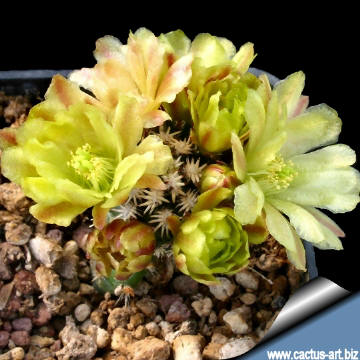
Yellow-green
whit a green
stigma
and yellow
pollen,
up to 2 cm across, (buds acute, reddish and yellow-greenish).
Phenology:
Blossoming
and
fruiting occur on 3 to 4 year-old plants.
Blooming period in cultivation is March-April.
|
 |
 |
|
. |
|
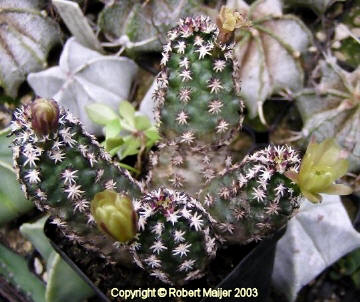
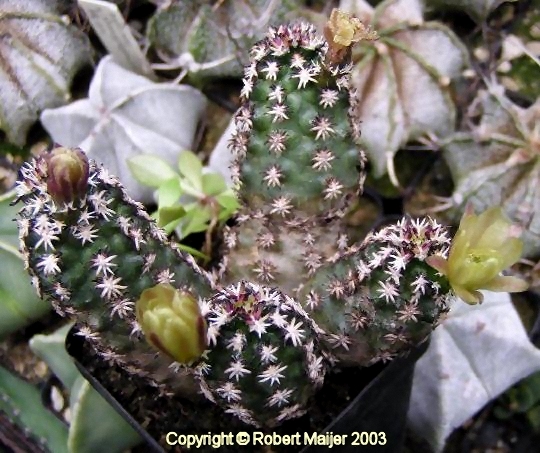
A plant in flower form
Robert Maijer collection.
|
 |
|
. |
|
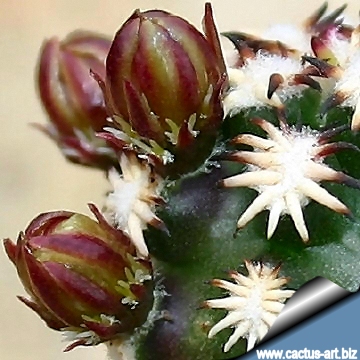
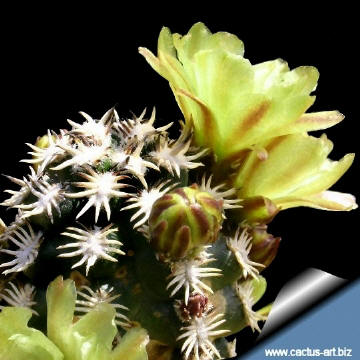
Buds show a
basal
crown of short yellowish spines. |
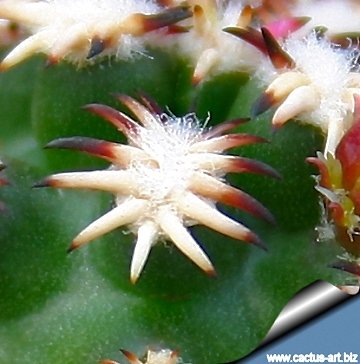
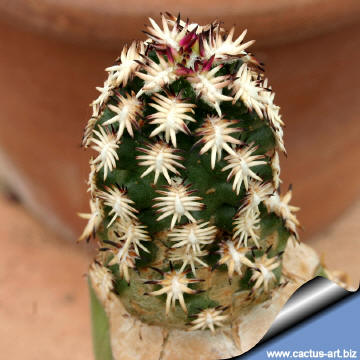
The
spines are short, stout and white
with a dark
red or black tip. |
|
Advertising
|
|
|
|
|
|
Family:
Cactaceae
(Cactus
Family)
Scientific name:
Echinocereus davisii
A.D. Houghton 1931
Published
in: Cact. & Succ. J (U.S.) 2: 466(1931)
cv. Brevispinus
This is the short spined
form of
E. davisii. It is
very beautiful and still rare in cultivation.
Origin:
Garden origin (Nursery
produced cultivar)

Distribution:
The standard species comes from a single
population
that
occurs in west Texas, (Brewster Co., Marathon)
Habitat:
Grows in flat hills on a specific
substrate (rich in
quartz
sand) in a
semi-desert grassland
at an elevation of 1,200 m Sometimes plants in
drought periods
shrink
well below
ground level.
Synonyms:
- Echinocereus
viridiflorus var. davisii
(A. D.
Houghton) W. T. Marshall in
Marshall & Bock.
Cactaceae: 119 (1941);
a
- Echinocereus viridiflorus
fa.
davisii (A. D.
Houghton) Krainz,
In: Kat. ZSS, 2a ed.: 51 (1967);
b
- Echinocereus chloranthus var.
davisii
(A. D.
Houghton) Cullmann
In Kakteen: 156, fig. 154 (1984) nomen invalidum (CINB,
art. 33.2); c
- Eechinocereus viridiflorus ssp. davisii (A. D. Houghton) N. P. Taylor
In Hunt. Cact.Cons. Init.
3: 10 (1997).
|
|
|
|
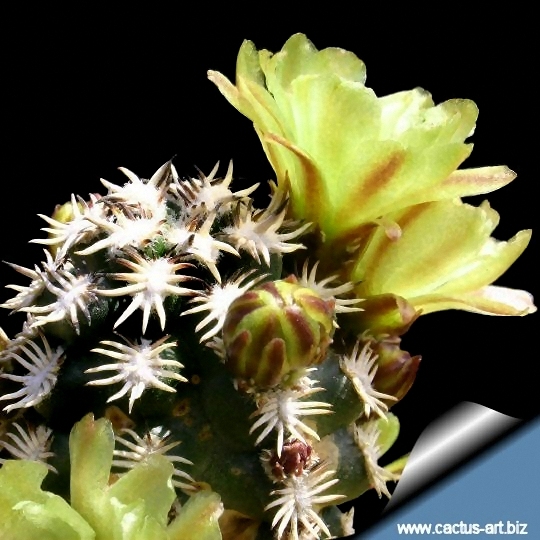
The
flowers
are yellow-green .

A small (2,5 cm) plant grafted on
Opuntia compressa.
This
grafting technique greatly enhances the production of flowers!
Cultivation: In culture E. davisii is without
problems but very slow growing and regularly shows its small green
flowers if we provide an adequate winter rest period. It is sensitive to overwatering (rot prone) needs
good drainage, Keep drier and cool in winter. Need full sun;
Very cold resistant hardy to -18° C or less for
short periods of time.
Propagation: Grafting, cuttings.
Photo of conspecific taxa, varieties, forms and
cultivars of Echinopsis davisii.
|
|

 |
|


 Cultivation and Mail Sale