|
|
|
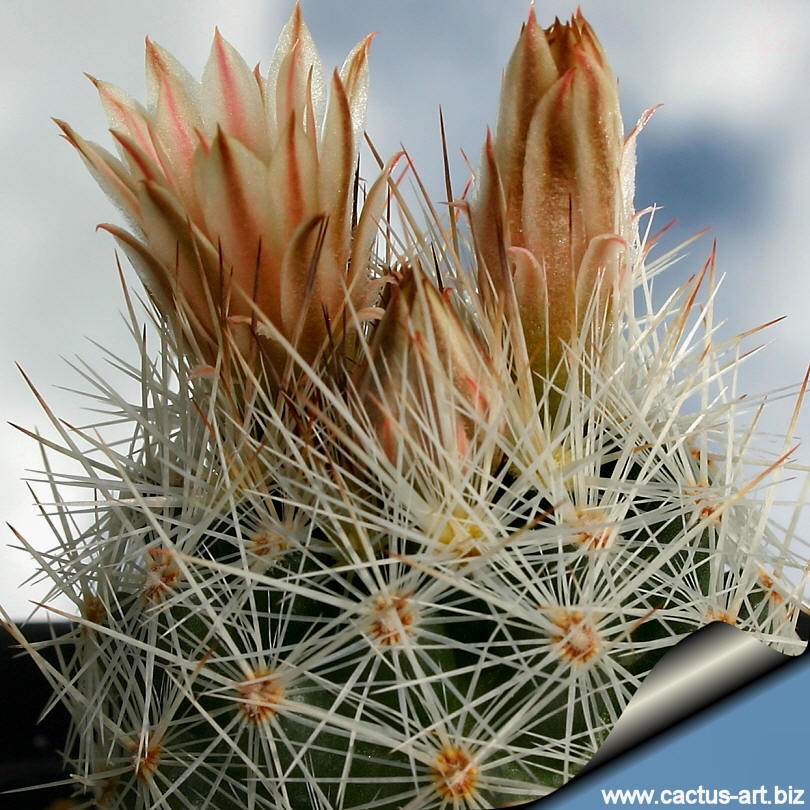
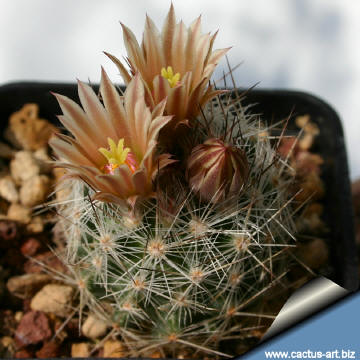
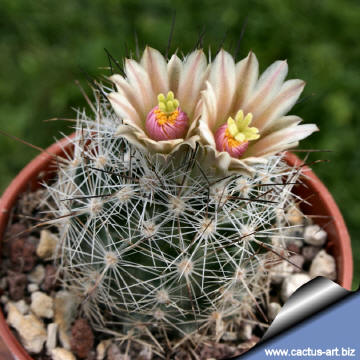
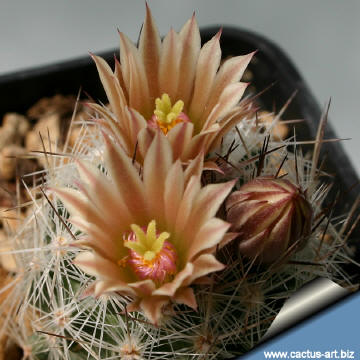
Escobaria duncanii SB467 Cuatrocienegas, Coahuila, Mexico
It is a small, globular, winter hardy plant with many spines on
tubercles.
|
|
Description: In the wild
the C. duncanii is an inconspicuous and difficult cactus to
identify, and usually rare. It normally stays solitary, or branches slowly
as it ages. It will form condensed upright cylinders, densely covered
with white spines with darker tips.
Stems: Mostly 1-2 cm across by 1-2 cm tall, hemispherical,
becoming short cylindric in age, but appearing conical due to spination.
Tubercles: Grooved on the upper side.
Spines: 30-75 per areole, slender and bristle-like, spreading, to
10 (22) mm long, pure white to brown, bristly with pink, red-brown to
nearly black tips
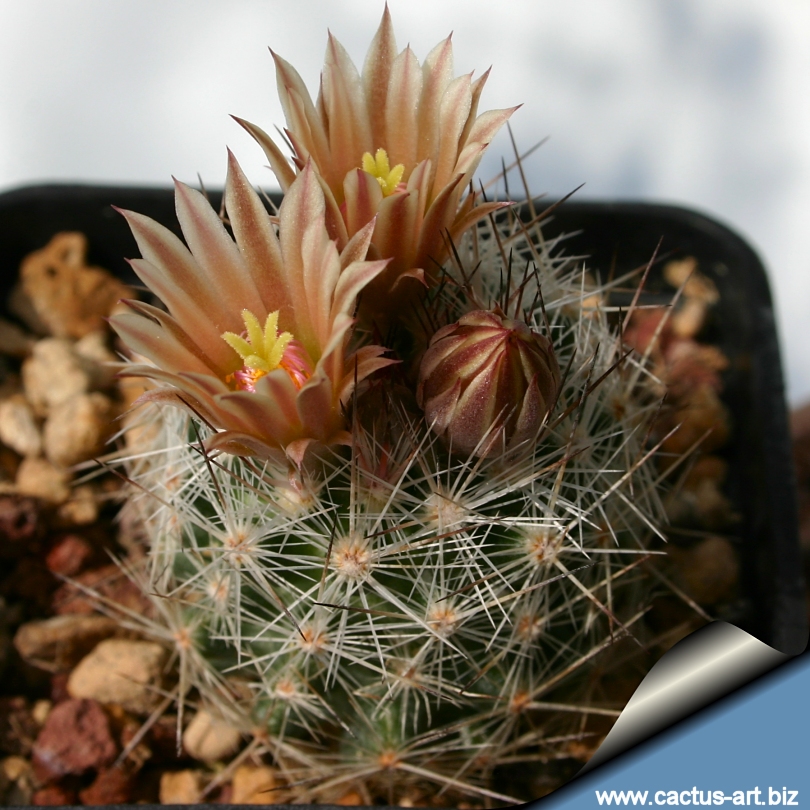
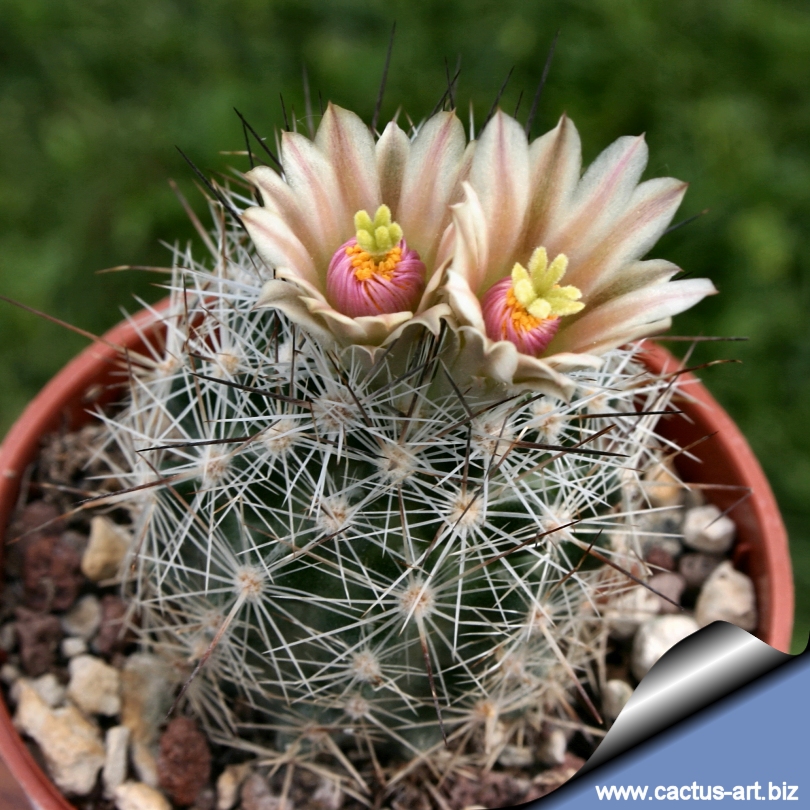
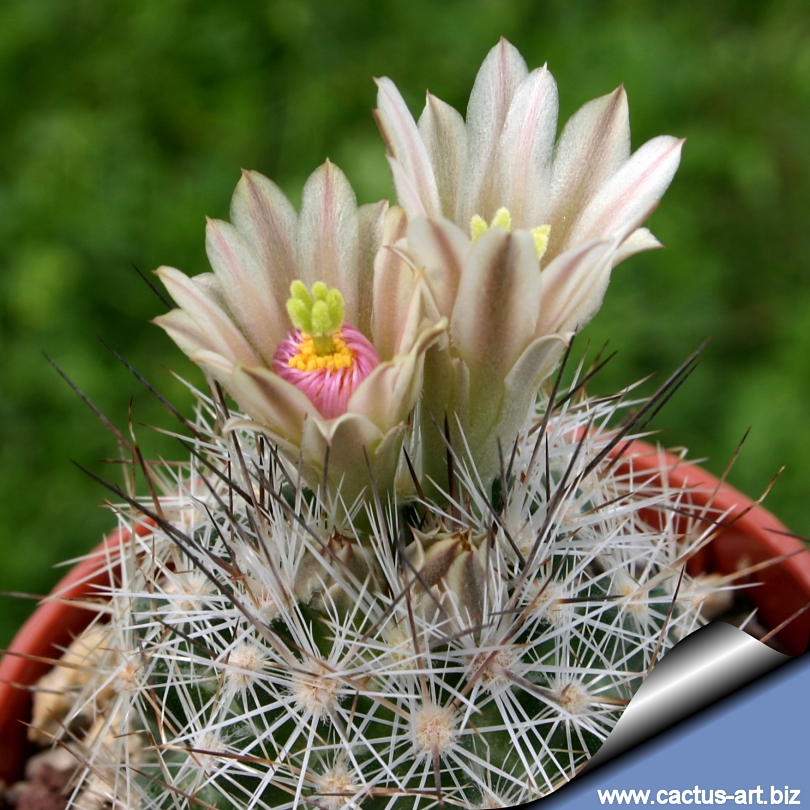
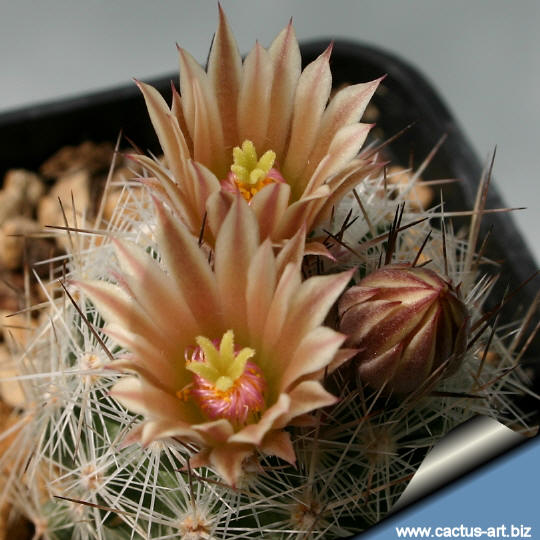
Flowers: About 1 cm wide, not opening widely, nearly apical, pale
whitie, brown, or pink with midribs darkest, stigmata green; perianth deciduous in flower.
Fruit: Mature fruits are elongate, about 1-2 cm long, bright red or
pinkish-red, floral remnant caducous.
Seeds: Black, about 1.5 mm long, nearly globose with rim around
basal hilum, pitted.
Blooming season: Flowers in April.
|
 |
 |
|
. |
 |
 |
|


Advertising
|
|
|
|
|
|
|
Family:
Cactaceae (Cactus
Family)
Scientific name:
Escobaria duncanii (Hester)
Backeberg,
Cactac. Handb. Kakteenk., 5 : 2966, 1961
Origin: New Mexico, central Sierra County; Texas, Brewster
and Presidio counties; adjacent Mexico, Coahuila and Chihuahua.
Habitat:
Cracks in limestone and limy shale in broken terrain in Chihuahuan
desert scrub; at1,550 m in New Mexico.
Conservation status: Listed in
CITES appendix 2.
Common Names include: Duncan pincushion cactus, Duncan's
Snowball Cactus Duncan's, foxtail cactus, beehive-cactus
Synonyms:
- Escobaria dasyacantha (Engelmann)
Britton et Rose var. duncanii (Hester) N.P.Taylor, 1983
- Escobesseya duncanii Hester,
Desert Pl. Life, 13 : 192, 1941, sine descr. lat.; et in Desert Pl.
Life, 17 : 24, 1945; cf. Gray Herb. Card Cat.
- Escobaria duncanii (Hester)
F.Buxbaum,
Kakteen, Lief. 14, CVIIIc. (Jul. 1960), in obs.
Coryphantha duncanii (Hester) L.D.Benson,
Cact. Succ. Journ. (US), 41 : 189, 1969
- Escobaria dasyacantha (Engelmann)
Britton et Rose var. duncanii (Hester) N.P.Taylor,
Kakt. und And. Sukk., 34(7) : 157, 1983
- Mammillaria duncanii (Hester) D.D.
Weniger, nom. nud.
- Escobaria dasyacantha subsp. duncanii
Similar Species: The green
stigmas, deciduous perianth in fruit, and black seeds readily
distinguish E. duncanii and
E. missouriensis from all other species. E. duncanii
differs from
E. missouriensis by the former's southern distribution, more
slender non-pubescent spines, and smaller seeds. E. duncanii
resembles a stunted, crevice-limited growth form of
C. dasyacantha, but has caducous floral remnants.
It is closely
related to C. zilziana Boedeker of Mexico.
|
|
|
|
Cultivation:
Easy to cultivate in a very gritty substrate with
much drainage. Water regularly in summer, but do not overwater (very rot
prone). It prefers a completely dry place during
the winter. Escobaria
ducanni is also quite successful to grows outdoors in the rock
garden, even though it does not grow very fast. It spends the winter
often covered by snow! The only problem is their tender root
system. If they are over-watered they will rot, so they are best grown in
a mineral mixture without any humus. Probably they cannot be grown
without protection in the coldest climates of northern Europe and Canada,
but in an unheated greenhouse they will do fine. They can survive low
temperatures (appr. -12 C).
Full
sun to light shade.
Propagation: Seeds (no
dormancy requirement, they
germinate best at 25°C) or usually by
offsets (readily
available),
or occasionally
grafted.
Photo of conspecific taxa, varieties,
forms and cultivars of plants
belonging to the
Escobaria tubercolsa
complex
(This
Taxon
has lots of synonyms whit
several controversial varieties and subspecies and comprises a multitude
of different forms, but where each form is linked to others by
populations of plants with intermediate
|
|


 Cultivation
and Mail Sale
Cultivation
and Mail Sale