|
|
|

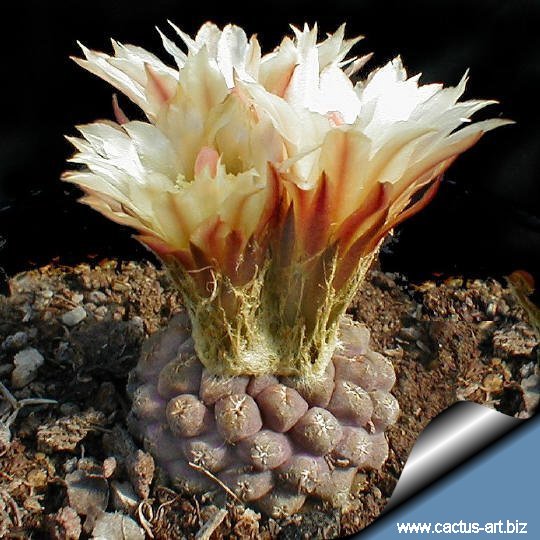
Eriosyce napina
(Field
number: FR249 East of Huasco, Atacama, Chile, Date: 1954/05)
|
|
 |
 |
 |
 |
|
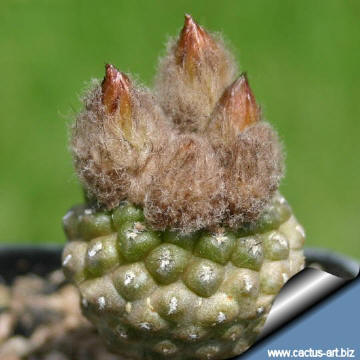
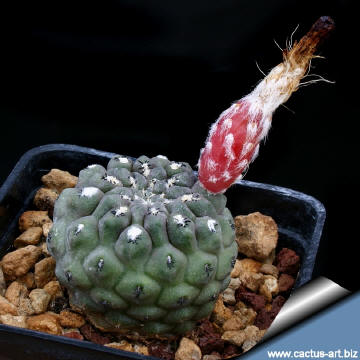
Budss & fruits |
|
|
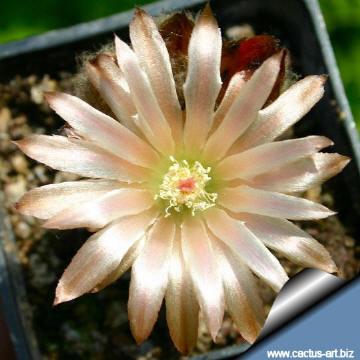
|
|
Photo of
conspecific taxa, varieties, forms and cultivars of E. napina.
(This
Taxon has lots of synonyms,
with several controversial varieties and
subspecies, and comprises a multitude of
different forms)
|
|


Advertising
|
|
|
|
Family:
Cactaceae (Cactus
Family)
Scientific Name:
Eriosyce
napina
(R. Philippi) F. Kattermann
Published in: Eriosyce (Cactaceae):
The genus revised and amplified 1: 118, 1994
Basionym:
Echinocactus napinus
Phil. 1872
Conservation status: Listed in
CITES appendix 2.
Etymology:
The
genus
name
"Eriosyce"
derives from the Greek words “Erion (εριον)”
meaning “wool” and “Sykos” meaning “fig (a
fruit)” .
(The genus name implies: “woolly
fruits”).
The
species name
“napina”
derives from the
Latin
“napus” meaning
"turnip”
plus the adjective suffix for nouns "inus" meaning
"belonging to or resembling"
(The specific name implies: “resembling
a turnip”)
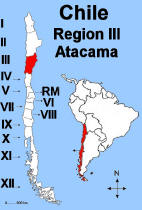
Distribution: From
coastal Chile (Region III Atacama) South of Freirina in the Huasco
valley (Atacama Desert)
Habitat: E. napina grows in one of the most
arid areas in the world, among rocky crags and sand dunes
in sandy-clayey soil in a
vegetable formation called “Costal desert of Huasco,”
a typical “desertic
mattoral” that is just spectacular and impressive when
it displays the phenomenon
of the
“flowering desert”.
Altitude around 200 m.
Synonyms:
- Neoporteria napina, (Philippi)
Backeberg 1935
in: Blatter Kakteenforsch., Pt. 9, [p. 4], 1935
- Neochilenia napina (Phil.) Backeb.
1942
- Thelocephala napina (Phil.) Y.Itô
1957
- Chileorebutia napina (Phil.)
F.Ritter (Nom inval.) 1959
- Chilenia napina (Phil.) Backeb.
1939
- Echinocactus mitis Phil. 1894
- Neochilenia mitis (Phil.) Backeb.
1959
- Neochilenia imitans Backeb. (Nom.
inval.) 1959
- Neochilenia neoreichei Backeb.
(Nom. inval.) 1959
- Reicheocactus neoreichei (Backeb.)
Backeb. (Nom. inval.) 1962
- Echinocactus napinus Phil. 1872
miniature
|
|
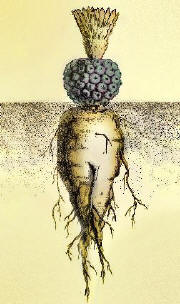 Description:
Tiny
geophyte, with
a
solitary
spherical or
flattened stem slowly growing atop a thick, underground
taproot,
with a
constriction between the stem and the root. eventually
becoming somewhat
elongated in cultivation. Description:
Tiny
geophyte, with
a
solitary
spherical or
flattened stem slowly growing atop a thick, underground
taproot,
with a
constriction between the stem and the root. eventually
becoming somewhat
elongated in cultivation.
Stem:
Slow
growing, up to 3-5 cm across, 2-6
cm tall,
ranging from green to brown, but more commonly with brown-olive-grey tones.
Tubercles : Larger than ssp. lembckei;
Areoles:
Grey.
Spines: Very short black
radials.
Roots: Forms
a
tuberous root system with (usually) a very
large
carrot-like root
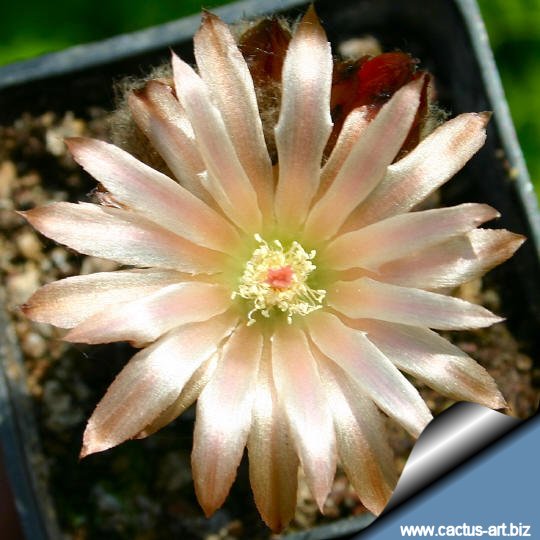
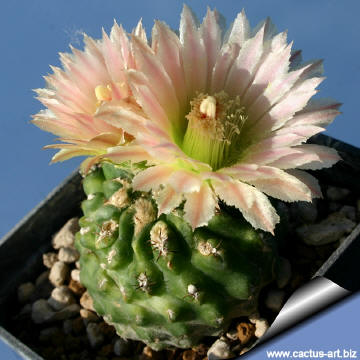
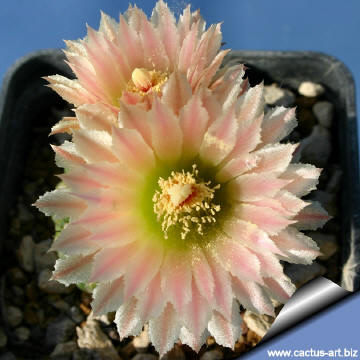
Flower: Approx
3,5 cm long, 4-6 cm in diameter,
whitish, yellowish, pinkish to pale brick-red with a
silky shine,
buds densely
hairy with brown
wool.
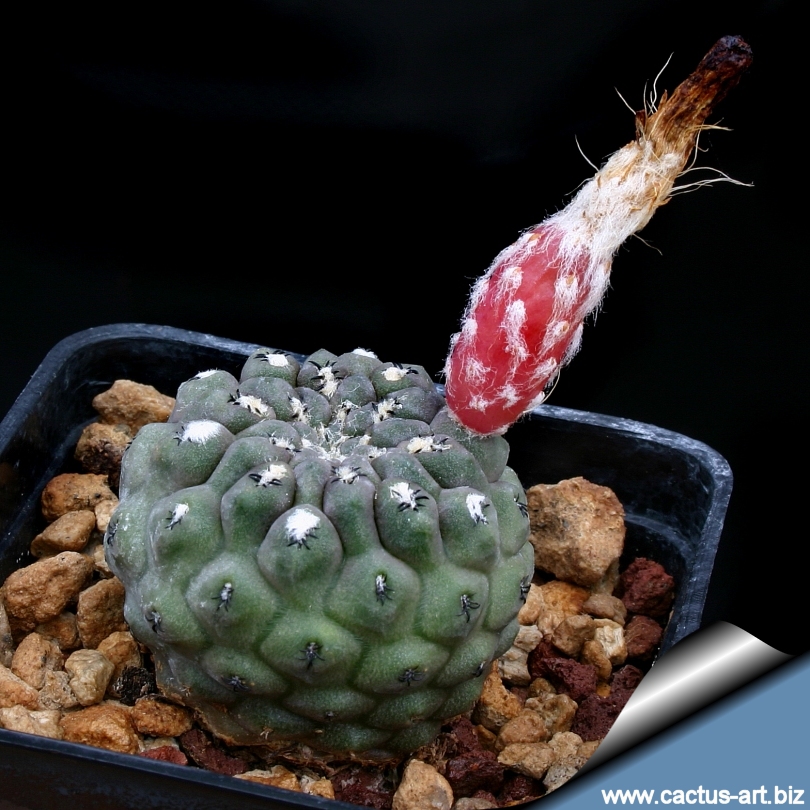
Fruit:
Large, red,
clavate,
wrapped in white
wool.
Phenology: Flowers
already when young,
synchronised flowering
of the whole plants takes place over one or two days, and they remain
open for about three or four days.
Blossoming time: late spring.
|
|
|
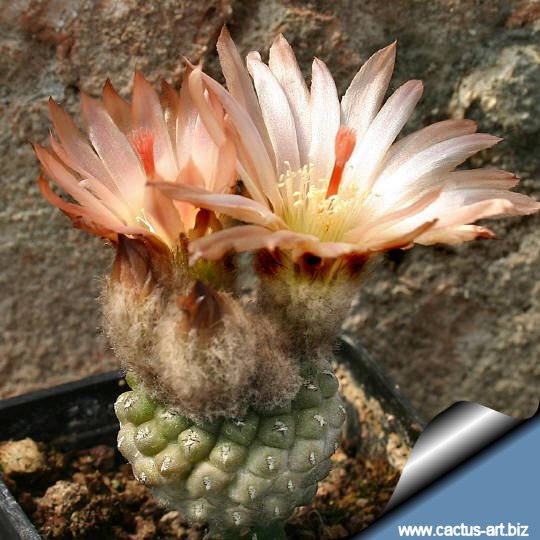
Eriosyce napina
KK18a, Huasco,
Chile 200m
A plant grafted on Opuntia compressa
Cultivation:
The eriosyces have a thick
taproot and are
susceptible
to
over-watering.
Sometimes they are
grafted to avoid
root
rot problems. Suited for
sunny-bright exposure;
they can
tolerate
light shade. They
like warmth (recommended minimum winter temperature 5° C). But plant
kept perfectly dry can easily survive in winter night temperatures below
0° C (In our greenhouse there was no damage at -10° C for a few hours in
the winter of 2002-2003 )
They prefer
airy exposures. They also need a deep pot and good
drainage, to accommodate its
tap root. Keep dry in
winter.
Pests &
diseases: E.
napina is especially
prone to rot, therefore,
underpot in a
smaller container filled with a very
porous compost.
Propagation: Seeds or
graft. Seeds can be sown in the spring or summer. The seedlings
should not be disturbed until they are well rooted, after which
they can be planted separately in small pots. |
|


 Cultivation and Mail Sale