Home | E-mail | Photo gallery | Mail Sale Catalogue | Grafting Guestbook | Dictionary |  Winter test | Links | Search

  Astrophytum capricorne var. niveum CACTUS ART
NURSERY

Cultivation and Mail Sale
of Cacti and Succulents.


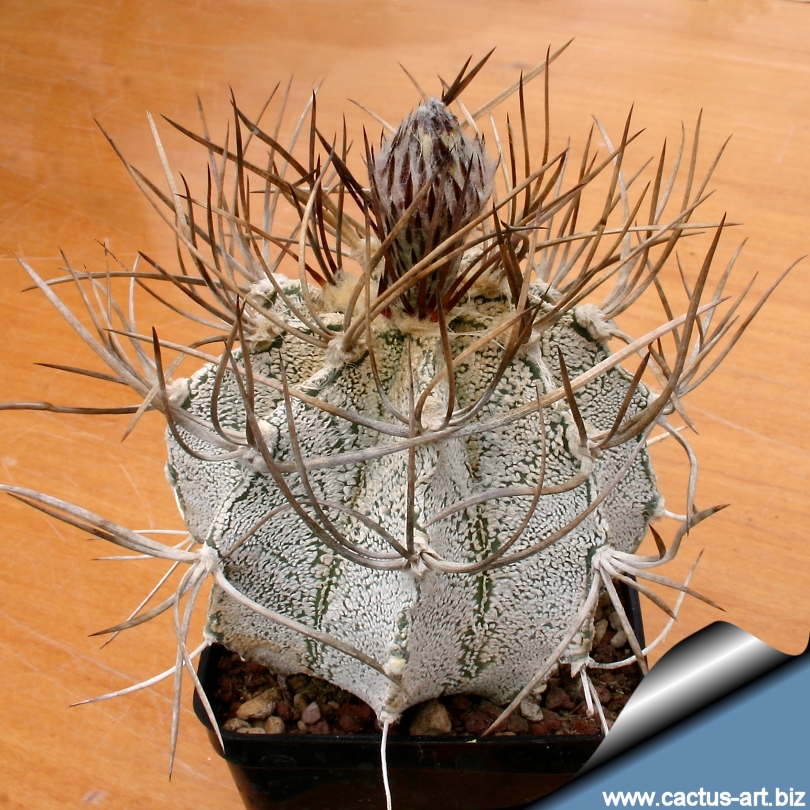
Astrophytum capricorne var. niveum  is a variety with striking  rigid thorns and very more closely whiter flocking, it  is indubitably one of the more beautiful of the astrophytums


Description: Astrophytum capricorne v. niveum is bigger than var. senilis and aureum, and its dimension are similar to the standard species.
Stem: Robust, at first globular then cylindrical up to 50 cm tall, diameter up to 20 cm (this size correspond in habitat to a 50 years old plant). The epidermis is densely covered with white flecks that give the plant a furry look. The hairy scales are pure white also in the new growth, while in the type species the new flecks are initially brownish and turn into white only lately.
Spines: 6-8 per areole, striking strong of variable size (max. 7-9 cm long) flat, bent upward and not very wavy. Brownish-blackish that turn grey-chalky as they age. Nice yellow and white spined  forms are also common in cultivation.
Flower: Medium sized, 7 cm (max. 9 cm) yellow with a red or orange throat.
Fruit: Fruit and seeds are identical to the standard species.

Astrophytum capricorne and its varieties are very variable in their habit even in small areas. And it is understandable that today we often have problems to decide to which population plants belong

Astrophytum capricorne var. niveum form nudum (Syn: Astrophytum capricorne var. crassispinum)
Recently (1985-1986) a curious A. niveum without the typical white flecks covering was fuond at about 10 kilometers on the west of Cuatro Cinegas. This ‘nudum’ form grows in association with normal white flecked specimens. This plant caused many confusions among botanists and collectors because it has been also indicated with a different name Astrophytum capricorne var. crassispinum.

Cultivation: Although regarded as a choice and difficult plant in cultivation it is relatively easy to grow. Use mineral well permeable substratum (rot prone). Water sparingly from March till October and keep perfectly dry in winter at temperatures from 5 to 15 degrees centigrade. (but it is Hardy to -7°C for short periods) In the rest period no high atmospheric humidity!! Sun Exposure: Light shade to full sun.


Photo gallery: Alphabetical listing of Cactus and Succulent pictures published in this site.

Photo gallery Astrophytum

Family: Cactaceae (Cactus Family)

Scientific name:  Astrophytum capricorne v. niveum OKUMURA, Y.
In: Classification of Astrophytum, Syaboten-no-Kenkyu 4: 174-175, 195-201, 215-216; Seite / page 174 (1933)
 

Origin Region of Cuatro Cinegas in the centre of the state of Coahuila (Mexico) The variety ’niveum’ is the more northern of the capricornes (Latitude 27° North)

Habitat: Desert of Chihuahua at an altitude of about 600 m among the impenetrable “Mesquite” woodland (spiny bushes) along with Lophophora williamsii, Ariocarpus fissuratus, Echinocactus horizonthalonius.
It grows in gravely soil among limestone rocks  in a very dry area (±180 mm rain/year mainly from May to September).
The temperature is very variable either seasonally and daily. Freezing temperatures in the winter are quite frequent. The insulation and luminosity are also very strong. The seed dispersion in habitat is pursued by ants.

Conservation status: Listed in CITES appendix 2.
This species is threatened and rare in nature.

Synonyms:  
  • Echinocactus capricornis v. niveus KAYSER, K.
    in: Echinocts. (Astroph.) capricornis niveus var. n. Kakteenkunde Jg. (1): 31-32. (1933)

NOTE: This variety has been discovered only on 1930 by Viereck on the North the town of Cuatro Cinegas, Kaiser made the first desription in 1933 with the name Echinocactus capricornis v. niveus, the same year Okomura renamed it with it actual name.


Photo of conspecific taxa, varieties, forms and cultivars of Astrophytum capricorne:

A Special Thanks to all Those Who help us to make this web site
This plant description is based on research and personal experiences and is too short to provide a comprehensive coverage of the subject. Do you see an error in what is shown? Or do you know more about the species than we are showing? Your help is greatly appreciated. Why not send us an email with further information or photos so that we can correct or extend the information provided?

The photos in  this site are subject to copyright. Images may not be copied, downloaded, or used in any way without the expressed, written permission of CACTUS ART nursery and the original photographer.

Home | E-mail | Photo gallery | Mail Sale Catalogue | Grafting Guestbook | Dictionary |  Winter test | Links | Search