|
|
|
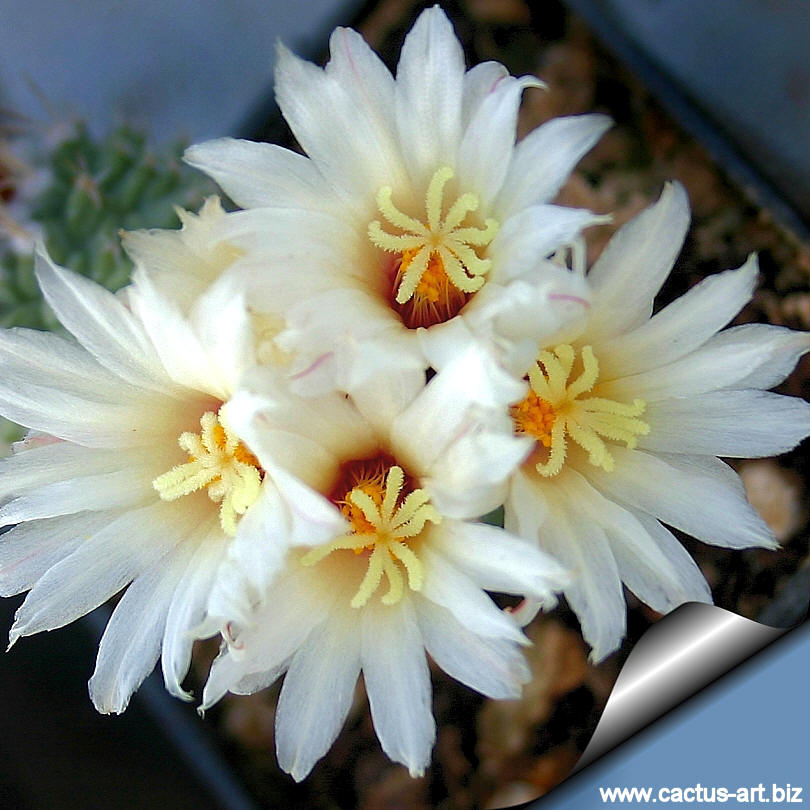
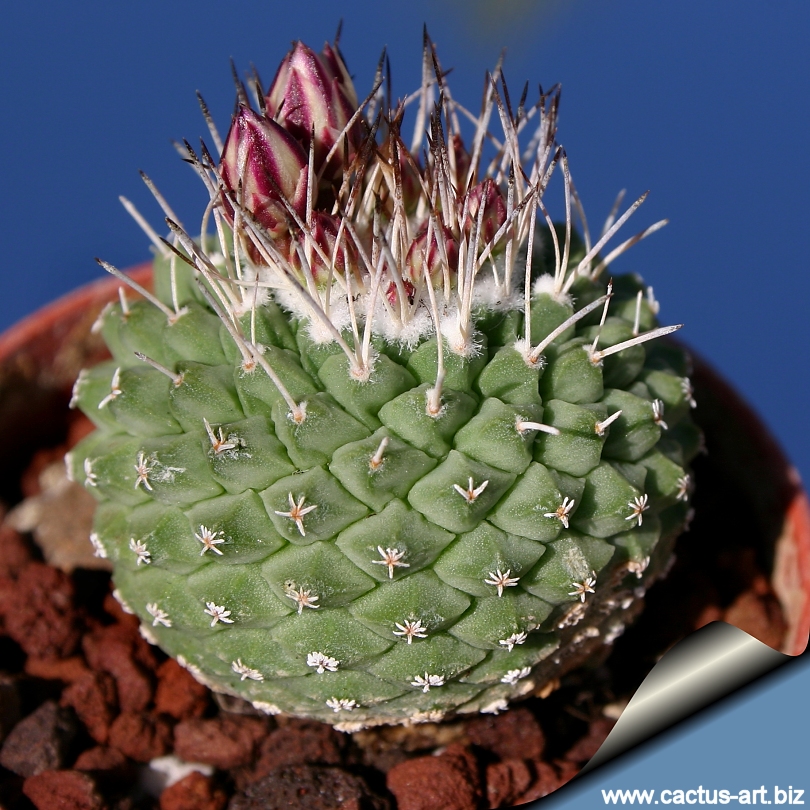
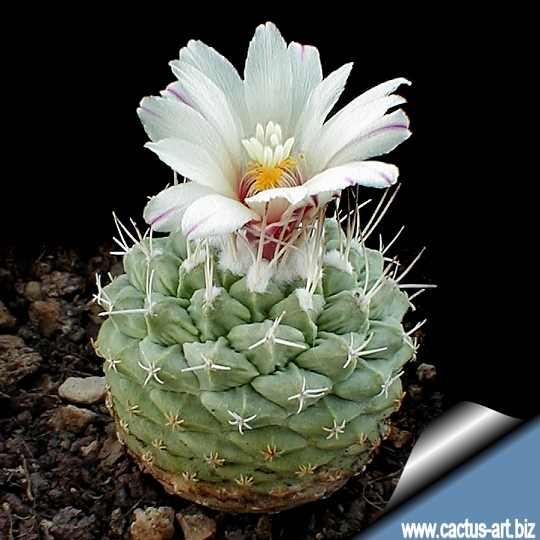
Strombocactus disciformis is a superb slow-growing miniature plant from Mexico.
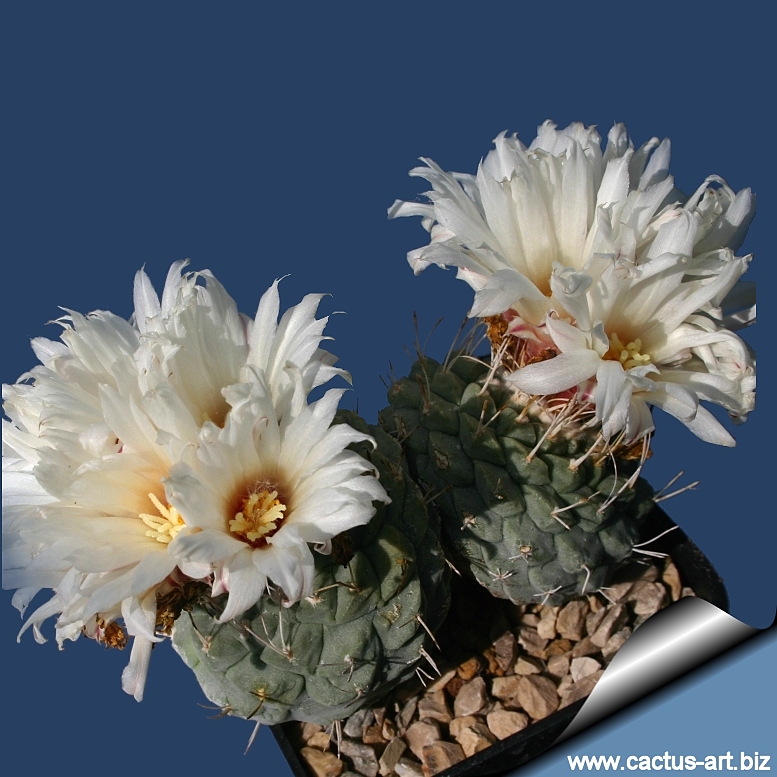
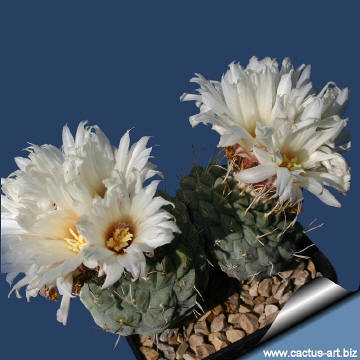
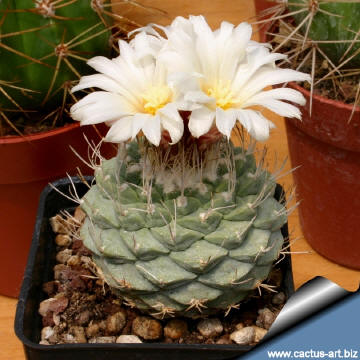
The cream
blooms
are freely produced throughout the
summer.
The 8 to 10
lobed
stigma is white or yellowish.
|
|
Description:
It is a rare
geophytes, usually
solitary.
Stem:
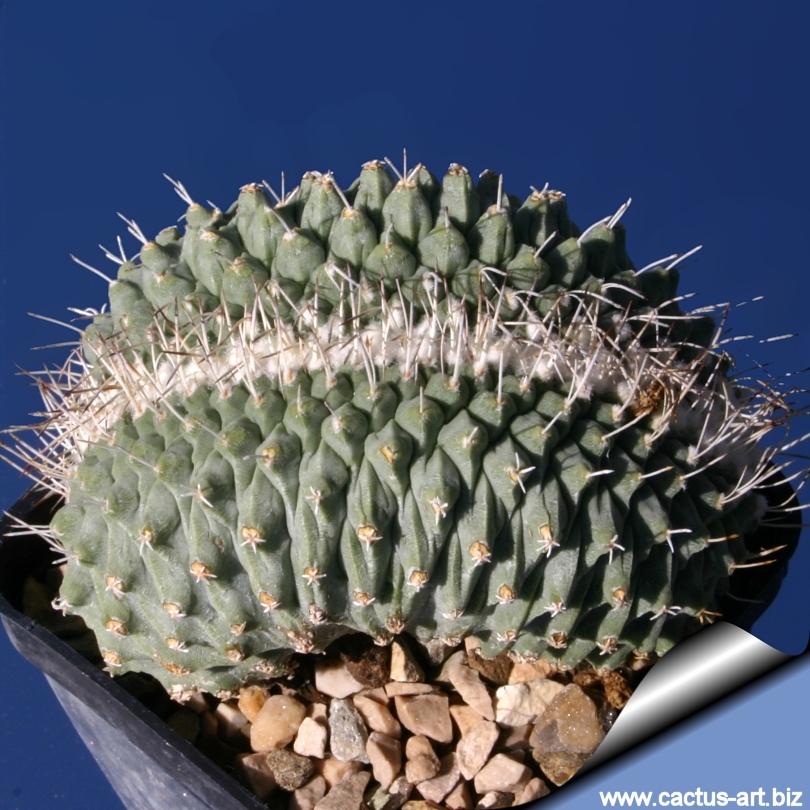
The body is
flattened or
spherical,
3 to 8 cm high,
reaching 20 cm in age, and 3 to 9 cm across. The
crown is slightly
depressed and
felted. The colour is blue-green with greyish tinge, the
base covered with brown
corky spots in
age. It is composed of hard,
spirally arranged
rhomboid and
imbricate tubercles,
1 to 1.8 cm high. These tubercules are flattened and almost
truncated above and somewhat
horny or
keeled below.
Spines:
4 to 5, erect and dark grey at the tips and pale grey at the base,
1.2 to 2 cm long, they become calcified, they are
caducous and in age fall at the stem base.
Roots:
Strong
napiform (turnip-like).
Flower:
Arise on the
crown, measure about 3.5 cm in length and breadth, are shiny
cream coloured with occasional spots at the tip and in the
throat, The
filaments are white or reddish, the
anthers yellow. The 8 to 10
lobed
stigma are white or yellowish.
Fruit:
7 mm across,
splits down its length.
Seeds: Very small.
Blossoming time: flowers emerge early in
spring and are freely produced throughout the
summer, remaining open for several days.
|
|
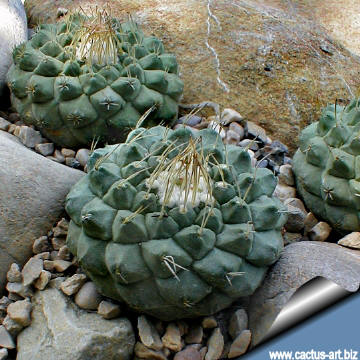
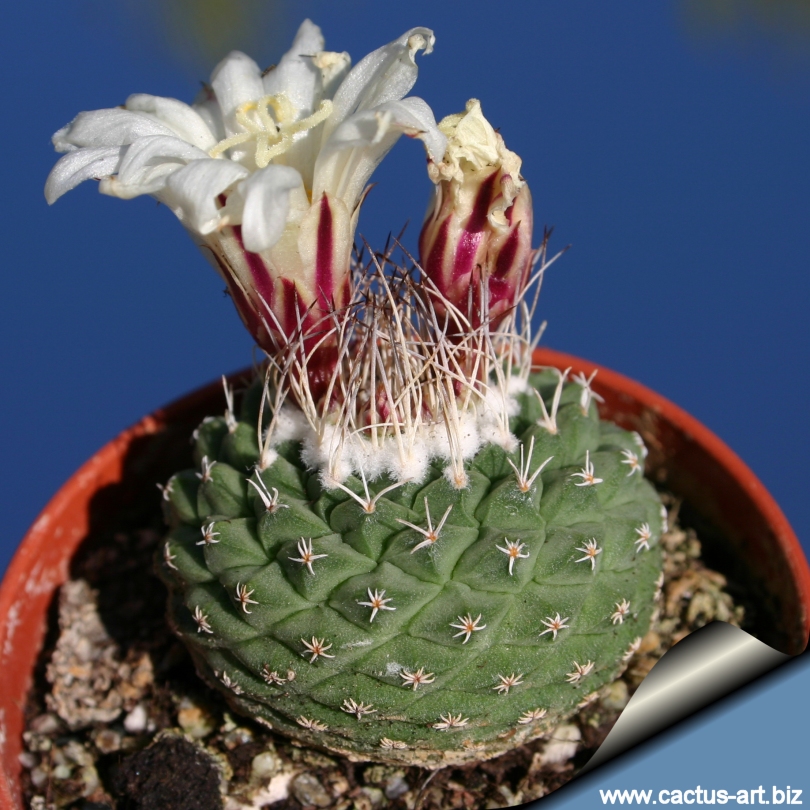
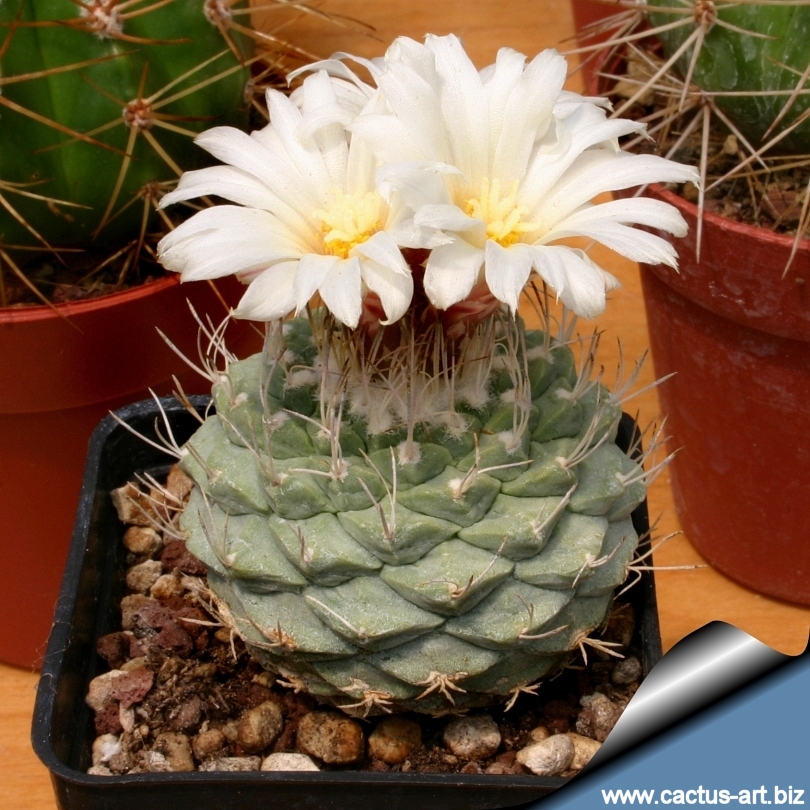
S. disciformis
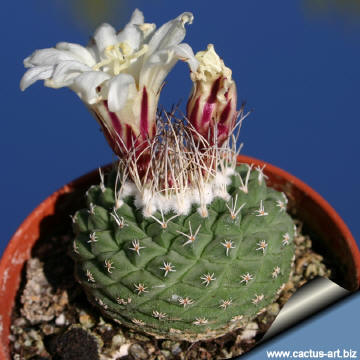
VB143 Villazon, Queretaro Mexico |
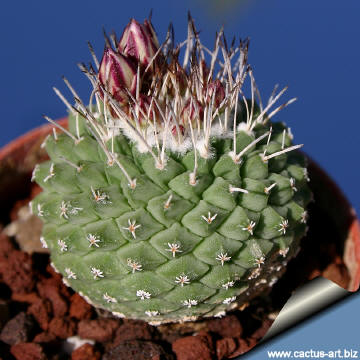
S. disciformis SB174 Villazon, Queretaro Mexico |
|
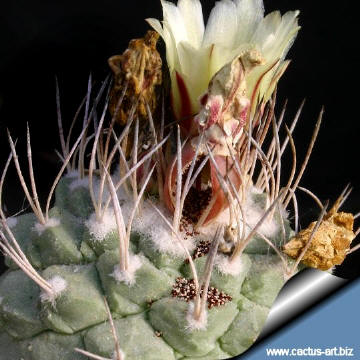
The ripe fruit (about 7 mm across)
splits
down its length releasing the minuscule seeds. |
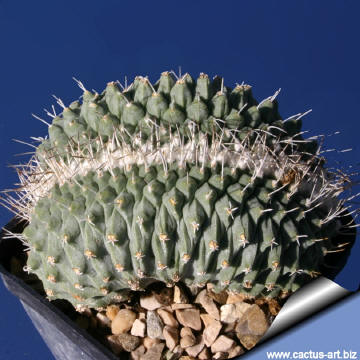
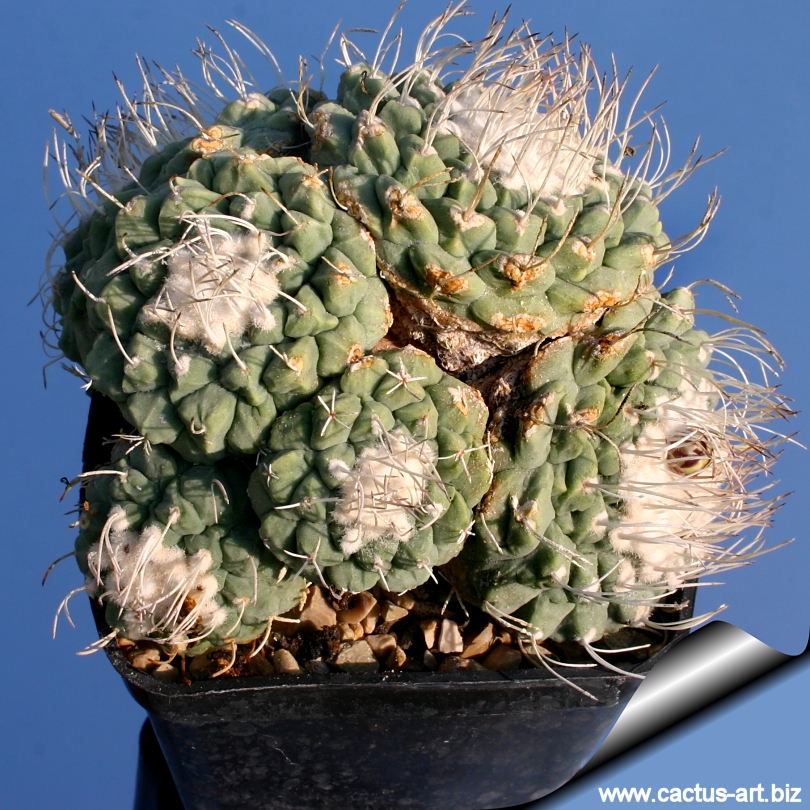
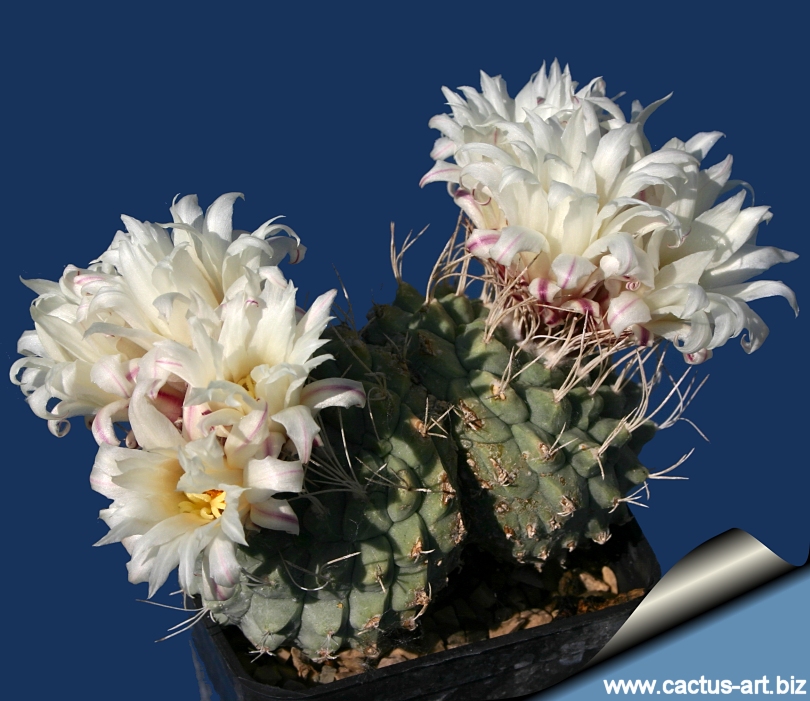
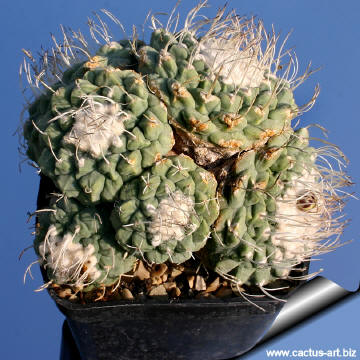
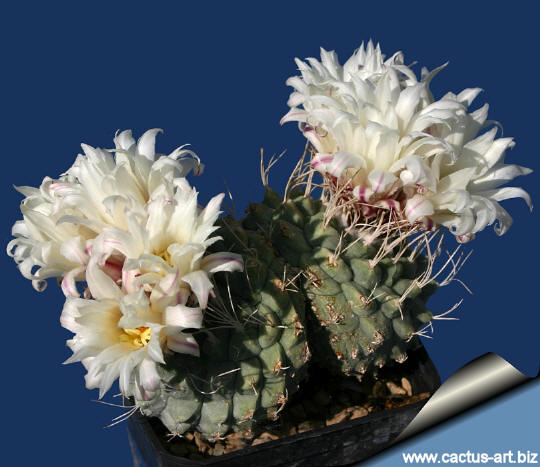
A rare crested form. |
|
 |
 |
|
. |
|
 |
 |
|
Cultivation: Although regarded as a choice and
difficult plant in cultivation it is relatively easy to grow, but very slow growing.
It is often seen as a grafted plant but grows very well on its own
roots too. Needs a very well drained
mineral substratum with little organic matter (peat, humus).
Requires strong sun to part sun to
develop good compact growth and waterings should be rather
infrequent, to keep the plant flat shaped and not become excessively
elongated and unnatural in appearance. Use Water
sparingly from
March till October and keep perfectly dry in
winter, or when night temperatures remain below 10° C (but some
people give this plant a light monthly watering to prevent the
drying and shedding of the lower tubercles.) It is hardy to -4°C (or
less) for a short period. In the rest period no high
atmospheric humidity!!
Ensure
a
good
ventilation.
|
|
Advertising
|
|
|
|
Family:
Cactaceae
(Cactus Family)
Scientific Name:
Strombocactus
disciformis
(De Candole) Britton & Rose
Published
in: The Cactaceae; descriptions and illustrations of plants of the
cactus family 3: 106-107, f. 115, 116, 1922
Basionym:
Mammillaria
disciformis DC., Mem. Mus. Hist.
Nat. Paris 17:114 (1828)
Distribution:
Mexico ( Quetaro, Hidalgo and Guanajuato )
Habitat:
In nearly vertical
limestone cliffs and slopes.
Conservation status: Listed in
CITES appendix I
Synonyms:
- Mammillaria disciformis A.P de Candolle 1828.
Published
in: Mem.
Mus. Hist. Nat. Paris 17:114 (1828);
- Echinocactus disciformis
(A.P de Candolle) K. Schumann 1894.
Published
in: Engler
and Pranti, Pflanzenfam. 36a:1 89 (1894);
- Ariocarpus
disciformis (A.P. de Candolle)
W.T. Marshall 1946.
Published
in: Cact.
Succ. J. Amer. 18:56 (1946).
- Echinofossulocactus
turbiniformis
Lawrence 1841
Published
in:
Loudon,
Gard. Mag. 17:318 (1841);
- Echinocactus turbiniformis
Pfeiffer 1838
Published
in: AlIg.
Gartenz. 6:275 (1838);
-
Mammillaria
turbinata
Hooker in Curtis 1843
Published
in:
Bot. Mag. 69:3984
(1843);
-
Cactus disciformis
Kuntze 1891
Published
in:
Rev. Gen. P1.
1:260 (1891);
-
Cactus turbinatus Kuntze 1891
Published
in:
Rev. Gen. P1.
1:261 (1891);
-
Anhalonium turbiniforme
Weber in Bois 1893
Published
in:
Dict.
Hort. 90
(1893);
-
Strombocactus (Turbinicarpus) disciformis (DC.)
Backbg.1936
Published
in: Blat.
Kakt. 1 (1936)].
Etymology:
The
genus
name
"Strombocactus" derives from the Greek word “strombos” meaning ""fir
cone, spinning top” treferring
to the shape of the plants,
and the word “cactus”
(an old genus name)
( The
genus name implies:
"fir cone cactus ").
The
species name
"disciformis" derives from the Latin
adjective “disciformis” which means
“disk-shaped, circular, flat,”
( The specific name implies: "disk
shaped")
|
|
|
 |
|
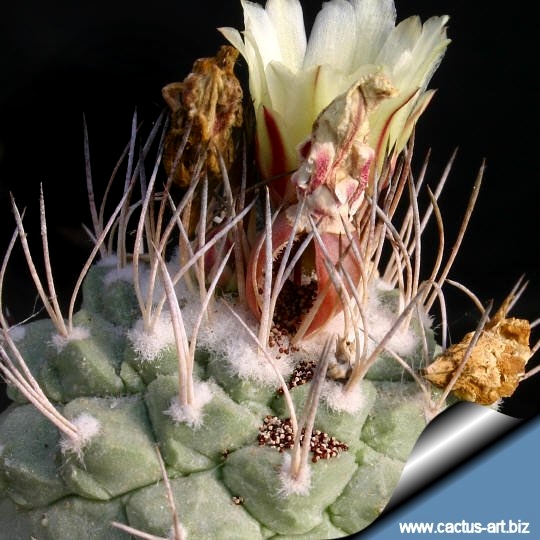
The ripe fruit (about7 mm across)
splits
down its length releasing the minuscule seeds.
Propagation: Almost exclusively by seeds.
But the
seedlings are tiny and
very slow growing and
at first they take one or two years to
reach the diameter of 1 mm!!! Once they have reached 4 years old
or more they are relatively easy to grow, the problem
is getting them to 4 years old! Than they reach 2 cm of diameter in
about 6/8 years, and require very careful watering. Plants need 8 to
10 years to reach
the flowering size.
Sometime, older specimens may shoot
tillers
from under tubercles, so they can be propagated by cuttings in
spring (but rooting may prove a challenge). Plants are
sometimes grafted onto column-shaped cacti, which is a much easier
way of propagation than sowing.
Photo of conspecific taxa, varieties, forms and cultivars of
strombocactus disciformis.

 |
|


 Cultivation and Mail Sale