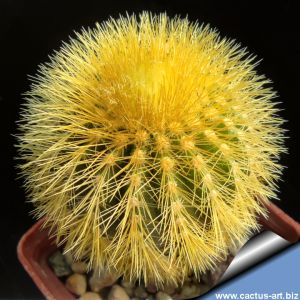
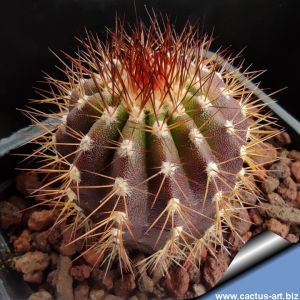
Rare form with golden-yellow spines resembling those of Eriocactus, contrasting sharply with black-spined varieties. It grows on quartz outcrops in Brazil (Minas Gerais), between 700–1,100 m, among
rocks.
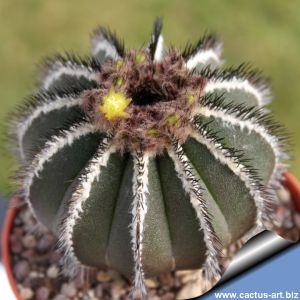
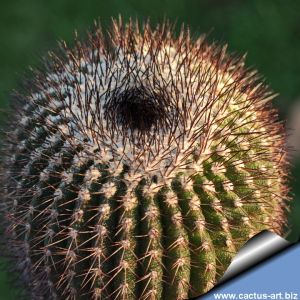
A solitary cactus with a continuous row of woolly white felt and black spines running along its ribs, resembling a fine-toothed comb. Its body ranges from greenish-red to reddish-brown, sometimes nearly black. Flowers diurnal yellow.
This is the Uebelmannia population found at the highest-elevation locality of the genus (1415 m), thriving in rocky highland environments with slightly cooler conditions than typical for the species.
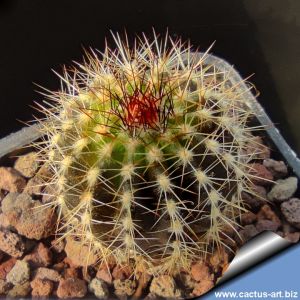
The southernmost known population of Uebelmannia grows at an elevation of 1220 m, thriving in rocky highland environments with slightly cooler conditions than typical for the species.
A geometric wonder with leathery green to bronze reptilian skin. Its woolly gray crown offsets amber-reddish juvenile spines that mature to graphite, all comb-aligned with mathematical precision. Nature's sculpture at its most symmetrical.