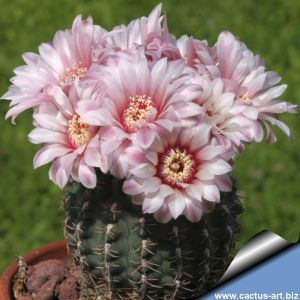
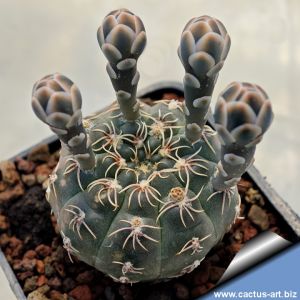
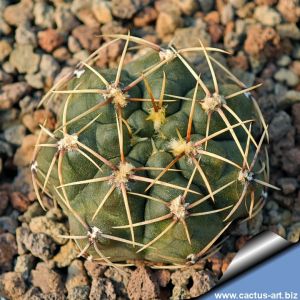
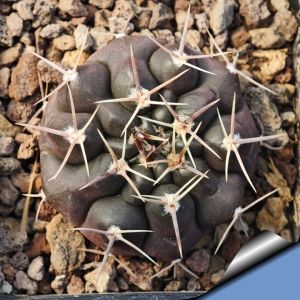
Extremely flat-growing Gymnocalycium, barely rising above soil level. Features attractive short spines and body color ranging from reddish to dark bluish-green. Flowers fade to pale pink to white when fully open, displaying a distinctive red throat.
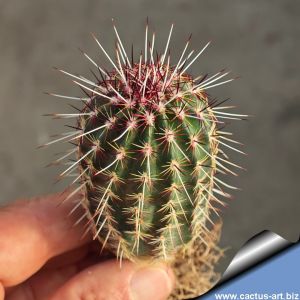
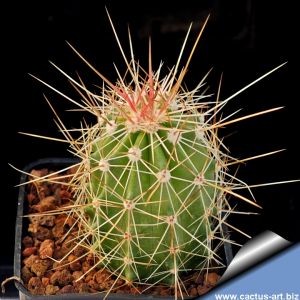
Group forming, long straight red-brown-white spines, huge pink flowrs. Grows together with Mammillaria setispina, Mammillaria dioica, Echinocereus ferreirianus and Ferocactus peninsulae.
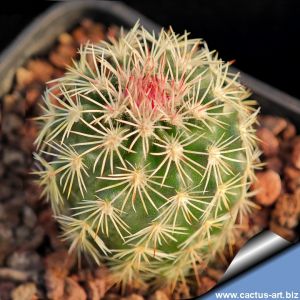
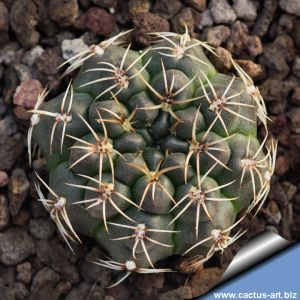
Cream-colored, spider-like spines sprout from large luminous areoles, weaving an nice pattern across the olive green plant’s body. A delicate and elegant contrast, a cactus with refined, unusual aesthetics.
Gymnocalycium taningaense features a small body that barely emerges from the ground, solitary but often branching at the base in cultivation. It is distinct from G. calochlorum due to its yellow flower throat (red in calochlorum) and narrower flower tube.
The variety pulvinicapitatus is a particular form of Discocactus placentiformis, distinguished by the shape of its body, which tends to be more flattened and develops a more pronounced and "cushion-like" cephalium.
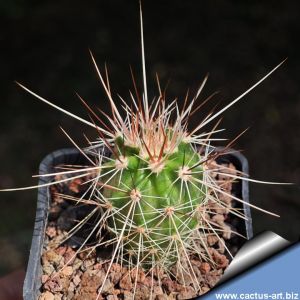
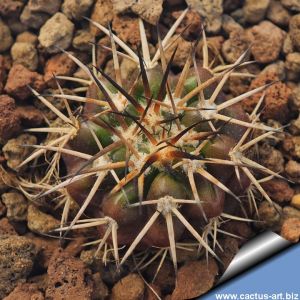
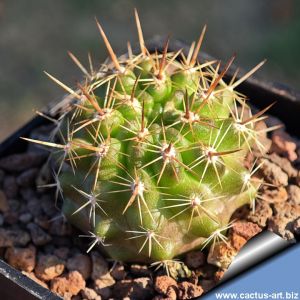
Tuberculate ribs bearing stout, long terete spines. Matures into an impressive specimen over time, developing a commanding presence that becomes the centerpiece of any collection.
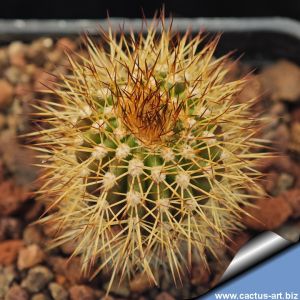
Solitary globular cactus with stems shifting from green to purple, topped by a woolly apex. Areoles are so densely packed they appear as near-continuous felt-like lines along the ribs. Honey-yellow, amber, or orange-brown spines.